
Curating an Exhibition as an Aphantasic
A curator with aphantasia confronts the ultimate irony: organizing a visual art exhibition without the ability to picture it. This personal account reveals how embracing alternative cognitive tools—narrative structure, physical experimentation, and collaborative feedback—turned a different way of thinking into a creative strength, resulting in a more intentional, story-driven exhibition that sparked the conversations about neurodiversity that mattered most.
6 min readByMaria Angele
I discovered I have aphantasia five years ago, and four years ago I wrote about it for the first time. (You’ll need to use Google Translate to read it). Since then, I’ve been trying to better understand how I process the world and in what ways that helps or hinders me.
In early March 2025, I applied for an artistic curatorial residency in the city where I live, fully convinced I didn’t stand a chance of getting in. Later that month I received an acceptance email stating: “We received many great applications and had a hard time deciding. But we’re happy to say we’ve managed to put together an interdisciplinary selection, with participants from various fields – and we’re sure you’ll have a lot to learn from one another. The good news is that you’re one of the selected participants!” At first, I’m happy. Then reality hits me as I quickly realize that curating means more than selecting some works; it also means visualizing them and arranging them in a coherent space. While thinking about what I could do and where I could start, I realized it might be another opportunity to talk about aphantasia, particularly in a visual artistic context. The exhibition stemmed from my personal search that began when I discovered I was aphantasic.
My goal, I decided, was to spark at least one conversation about aphantasia or hyperphantasia.
The Curating Process
A few years ago, visual artist Bianca Milea presented her graduation project about the extremes of the imagination spectrum. I thought she would be a good fit to represent the aphantasia side of the exhibition. Though she doesn’t have aphantasia, I chose her knowing that she had a good understanding of aphantasia. Then, I needed an artist to represent hyperphantasia. Ruxandra Tudoran’s works stuck with me after I came across them while going through numerous portfolios. Even though I could no longer picture them in my mind, I kept thinking about them. I felt that the two could be placed in the same context and that they would work well together.
I went through several stages of impostor syndrome. I constantly felt like I was doing things wrong or poorly, especially because I had no comparable previous experience, but I kept going, focused on my goal: to spark at least one conversation about aphantasia or hyperphantasia.
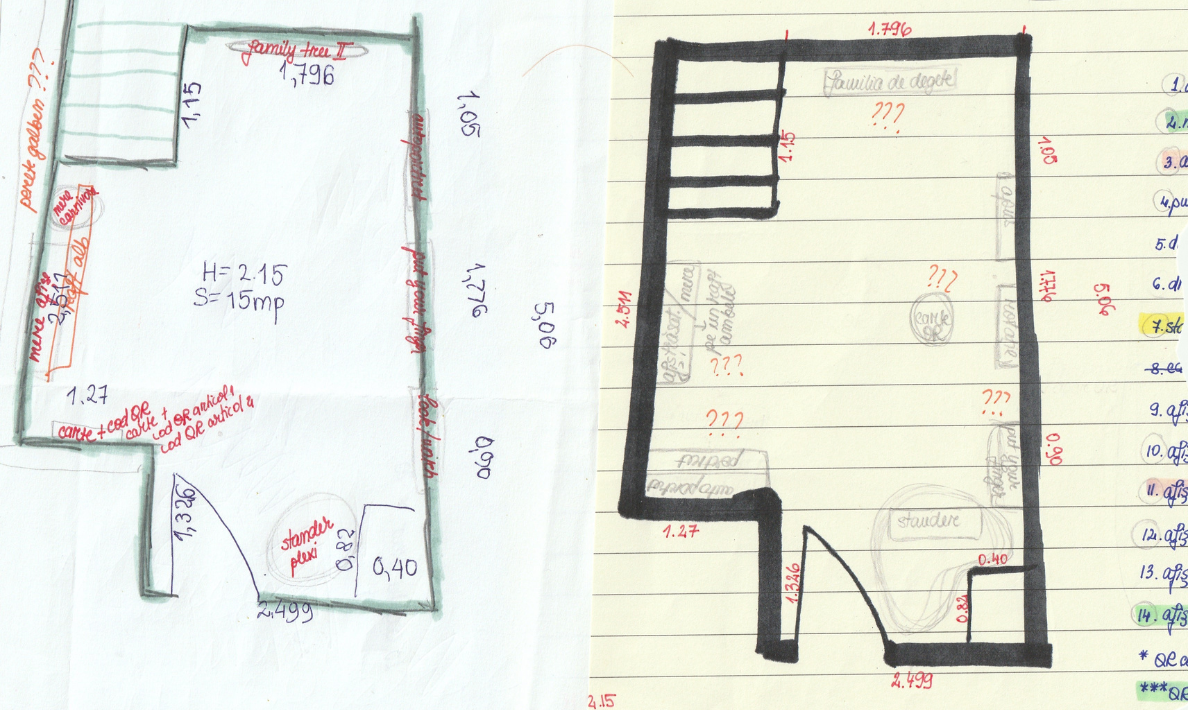
I drew the space measurements by hand and started sketching over them. I redid the sketches over and over until something started to take shape. When I felt lost and couldn’t imagine what a certain piece would look like in the space, I turned to others for help. It was very hard for me to figure out on my own what I needed to do, and I constantly needed guidance and validation, especially regarding arrangement. After drawing five versions of the space, I consulted with the artists with whom I was working and came up with an idea that seemed final to me.
All the panic of not knowing where to put the works disappeared completely when, once I arrived at the space, I started taking the works out of the boxes and asking people to hold them up against the wall. I looked at how the works looked, moved them around, looked at them from different angles, and, step by step, I arrived at a result. Bird by bird; work by work.
What I forgot to take into account when I started doubting myself is that there is a process behind every action. I was reading a lot about artists who draw step by step, but failed to connect their experience to mine. What I often forget is that I don't have to have a final product from the start. It can change along the way, and that's okay. The final product is the sum of all the attempts before, the sum of the whole process, sometimes stumbling, other times finding the easy path.
The Exhibition’s Story
I also realized that my strengths lie in the way I manage to put together stories, which are most often not visual. I chose to focus more on the story behind the exhibition, on the way I guide a person through it. The exhibition unfolds like one: it moves from theory and awareness to the relationship between people with (a/hyper)phantasia and the surrounding world (whether we are talking about other people or objects), to the relationship with the interior and family heritage. As they move from one work to another, visitors are encouraged to test their visualization skills and ask themselves questions about how they process the world.
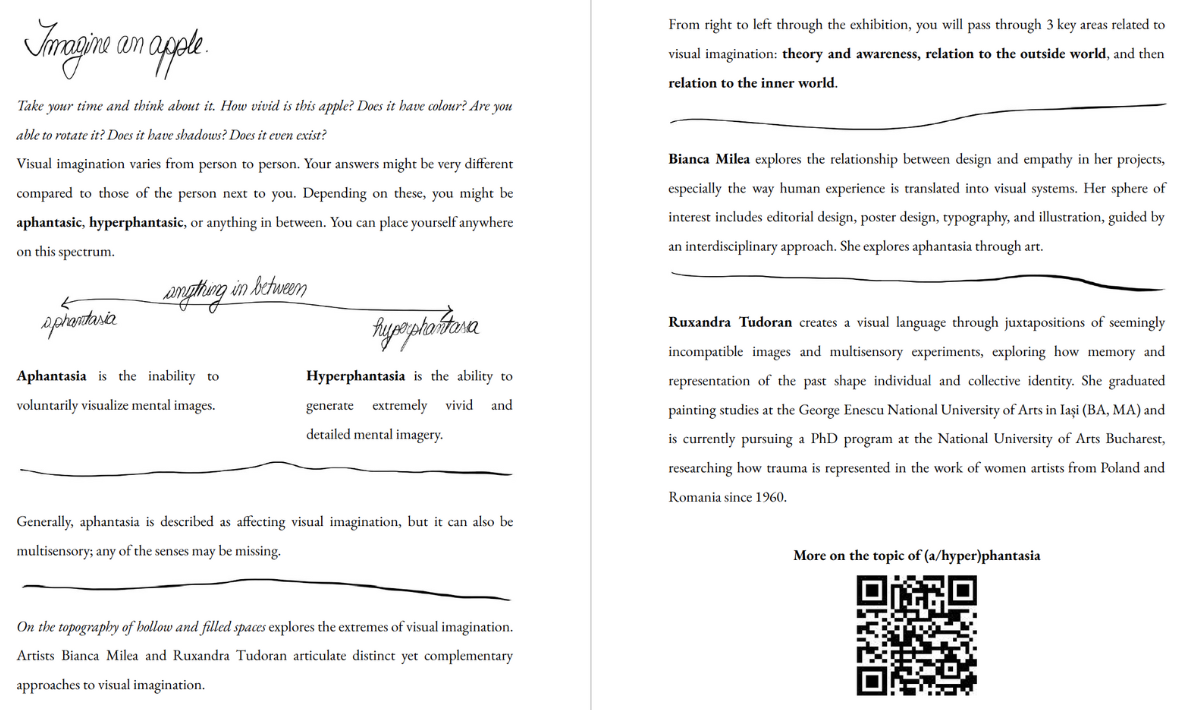
Chapter 1 of the exhibit, Theory and Awareness, contains the book A/Phantasia, Bianca Milea's thesis, which provides theoretical context and visualization exercises to understand how perception differs. There is also a Mental Template, a visual exercise based on mind maps that translate concepts (contour, texture, color, etc.) into visual codes where visitors are invited to rearrange the elements to create a coherent image.
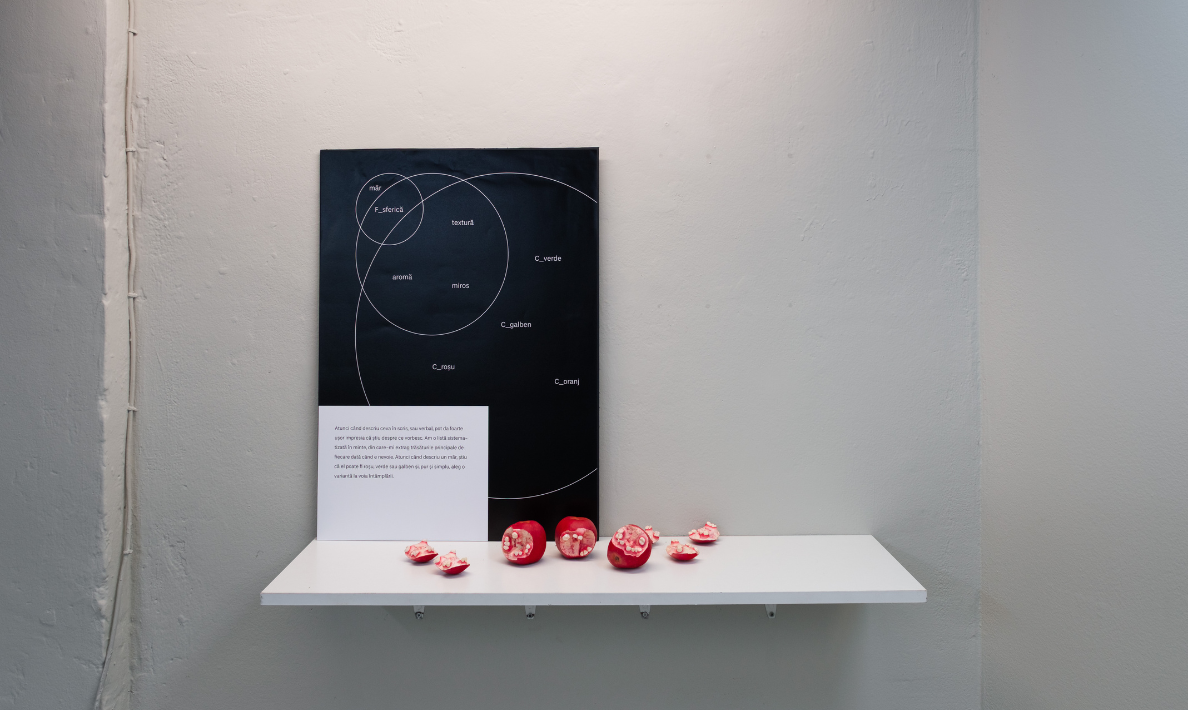
In the second chapter, Relationship with the Outside World, we find posters that simulate the sensory information of a planned route and test the ability to imagine a loved one through a series of images that lose their clarity. The two portraits contrast two types of mental representation: one based on lists and features, the other on intense bodily details. The idea of the apple appears in the contrast between the poster that deconstructs the way an aphantasic conceptualizes an apple and the ”carnivorous”, hyperphantasic apples.
The last chapter, Relationship With the Inner World, invites the viewer to intimacy and empathy through physical proximity to hidden details. And the painting evoking Tomas' biblical gesture suggests the need for direct experience in order to understand someone else's experience. The installation explores physical and psychological heritage, representing it violently through dysmorphic fingers and butchery elements.
The ending brings you back to the starting point, completing the introspective circle of the exhibition: an invitation to reflect on how we see (or do not see) the world, both outside and inside ourselves.
"Finally, I know someone else like me," someone told me after visiting the exhibition.
We started talking and sharing our experiences. Some time later, a second person confessed to me that they have aphantasia. From there, another discussion began, from which I emerged feeling even more fulfilled. I had accomplished my goal.
To any aphantasic who hesitates before taking on a project that seems impossible because the main tools to be used are visual, don't think twice. You have many other tools at your disposal.
The Exhibition
On the topography of hollow and filled spaces, the exhibition, was hosted at MATCA artspace in Cluj-Napoca, Romania this past July and August (2025). The show brought together the works of artists Ruxandra Tudoran and Bianca Milea, exploring the extremes of the mental visualisation spectrum: aphantasia and hyperphantasia.
MATCA artspace
MATCA artspace is an independent artist-run space in Cluj-Napoca, repurposed from a former leathercraft workshop. Founded in 2017 by Alexandra Mocan, Alexandru Muraru, and Matei Toșa, the space was initiated to address the need for accessible platforms for local artists. MATCA explores and reflects on the evolution of contemporary art, current trends, recent global events, and the ways artistic discourse develops around them. Through events and exhibitions, the space serves as a medium for discovering local art while facilitating dialogue between emerging and established artists, both local and international. MATCA encourages experimentation with alternative media beyond traditional formats and operates on a non-commercial basis. To date, MATCA has organized over 70 exhibitions and collaborated with approximately 300 artists. Recent projects reflect a focus on cultural and artistic work, as well as an orientation towards research-driven, dialogue-based, and participatory practices. In this context, the space has recently launched residency programs, discussions, and workshops.