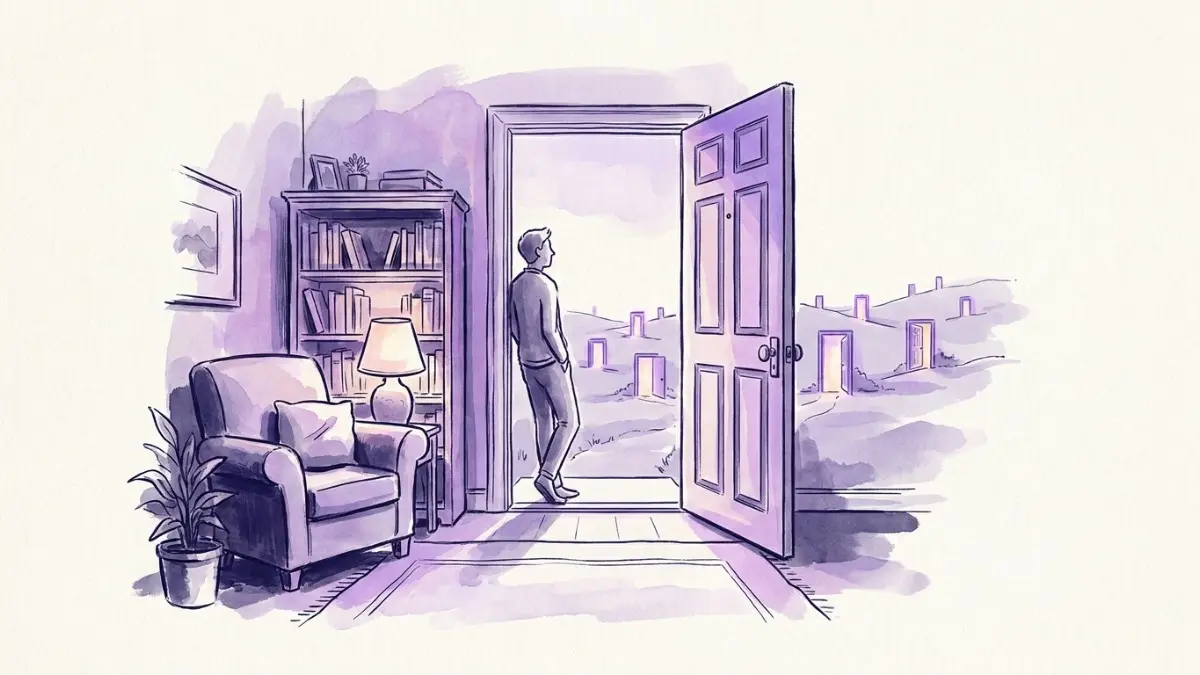
You found the word. Now map the mind behind it.

The test gave you a score and the internet gave you the word. Neither tells you what it means for your memory, your relationships, or the next time a therapist asks you to picture a safe place. Seven modules, about three hours, read or listen. The first two are free.

It starts with your result, not the definition.

Module 2 reads your VVIQ band properly and checks your other inner senses. That is where your Mind Profile opens, and every lesson after it adds an entry.

You leave with proof, not just a label.

Pupils, skin conductance, binocular rivalry, and why you cannot practice your way into picturing. Written as the reply to "you are just not trying hard enough."

And the words to explain it.

Your own three sentences, built from templates. Plus what to say to a partner, a parent, a teacher, and the next therapist you see.

Person discovering they have aphantasia and finding their community

97.2K+

World's largest aphantasia community

10+ years

Learning and building together

NYT, BBC

Trusted source for aphantasia

The moments that made you wonder if something was wrong

Every one of these turns up in our inbox, most weeks, from people who thought they were the only one

Sound familiar?

  • The meditation track that told you to picture a warm light, while you sat there with nothing, wondering how everyone else was doing it
  • The memory palace that was going to change your life, except you could never build the palace
  • The therapist who asked you to picture a safe place, and you went through the motions rather than keep correcting them
  • Every conversation where someone said they could see it in their mind, and you nodded along, half sure they were exaggerating

What we know now

  • About 1 in 25 people, around 4%, have functional aphantasia: imagery too faint or absent to use
  • It is a cognitive variation, not a disorder. Researchers have found no evidence it's pathological
  • Most people find out in adulthood. The median age of discovery is around 30, so you are not late, you are typical
  • The strategies that work for your mind already exist. Nobody ever taught them to you

Aphantasia Explained

7 modules, about three hours • Read or listen • First two modules free

Written from ten years of community messages, the research we help run, and the counsellor course that trains clinicians in the same material.

Welcome: You are not brokenFree
1. How minds differFree · 5 lessons
2. Your starting profileFree · 3 lessons
3. The proof4 lessons
4. Your everyday life6 lessons
5. Your relationships5 lessons
6. Your wellbeing4 lessons
7. Your people, and what's next4 lessons

What you get that an article cannot give you

Anyone can have aphantasia explained to them free, by our own guide or by any AI. This is the part that has to be built with you

A profile of your own mind

  • Your VVIQ result read properly, against our norms
  • Which of your inner senses are loud, and which are silent
  • How you hold memories, checked rather than assumed
  • The strategies that fit the mind you actually have
  • One dated page at the end, yours to keep and share

The named thing: your Mind Profile. It opens in Module 2 with your VVIQ result and takes a deposit from every lesson after it.

Evidence you can hand someone

  • Pupils that respond to imagined brightness, and what happens when they do not
  • Skin conductance to a frightening script, and the reading that changes everything
  • Binocular rivalry, the test that is hard to fake either way
  • Why you cannot practice your way into picturing
  • A proof card that goes into your profile

Why it matters: the most common thing said to a person with aphantasia is that they are not trying hard enough. Module 3 is written as the reply.

The conversations you have been avoiding

  • Your explanation in three sentences, in your own words
  • Being read as cold or uninterested, and how to head it off
  • Partners: what "I will picture you the whole flight" gets replaced with
  • Parenting a child whose school assumes a mind's eye
  • What to tell a therapist, and how to find one who already knows

Also in the box: a lesson written for the person reading over your shoulder, so you can hand the course to someone instead of explaining it again.

What you walk away with

Six things you hold at the end, in the order the course builds them

Read your own result properly

What your VVIQ score actually means, which band you land in, and how your other inner senses check out. This is where your Mind Profile opens.

Proof you can cite

Pupils, skin conductance, binocular rivalry, and what the one careful training study actually found. Enough to answer "you are just not trying" without raising your voice.

How you actually hold your past

Your memory tests better than it feels. Researchers call the difference the confidence gap. You get the strategies that fit a mind that keeps knowledge, space and meaning instead of playback.

Words for the people in your life

Your own explanation, three sentences, built from templates and written in your voice. Plus what to say to a partner, a parent, a teacher, and the next therapist who asks you to picture a safe place.

Somewhere to put the heavy days

Late discovery hits some people hard and barely touches others. Both are on schedule. The wellbeing module covers grief, related traits, and how to find therapy that fits.

Your Mind Profile, finished

Every entry you deposited along the way, rendered as one dated page you can keep, print and share. The next new therapist or teacher conversation starts from a document instead of a blank stare.

Built by Someone Who Gets It

From the Founder
Tom Ebeyer, Founder, Aphantasia Network

Hi, I'm Tom

Founder, Aphantasia Network

I found out at 20 that when people said "picture this," they meant it. I had spent two decades assuming it was a figure of speech.

The first feeling was not relief. It was that something had been taken from me that everyone else got to keep, and nobody had thought to mention it.

What changed it was other people. I started writing about it, and the replies came in by the thousand, all saying the same sentence back to me: I thought I was the only one.

Aphantasia Network came out of those replies. Ten years on it runs the research collaborations, the VVIQ that most people arrive here holding, and the clinician training. This course is the thing I wanted at 20 and could not find.

It will not hand you your mind's eye. No method does, and the course says so plainly in Module 3. What it hands you is your own mind, mapped, and the words to pass it on.

~ Tom Ebeyer, Founder

As Seen On

New York TimesBBCForbesThe Wall Street Journal

Read first, decide after

Read the first two modules for nothing. Buying only covers the five that follow.

Try it before you pay

The welcome, How Minds Differ and Your Starting Profile are free to any signed-in account. Your Mind Profile opens in module two.

$29 now, $49 at launch

Founding pricing closes when the founding places do. The live count sits next to the pricing below.

Thirty days to change your mind

Full refund on request, no reason needed. Read the free modules first and most of the question answers itself.

Already a member?

Annual and lifetime members already have the whole course. Sign in and open it, there is nothing to buy.

Check your membership status →

Questions About the Course

What people ask before they start

Getting started
4 questions

Course content
4 questions

Practical questions
3 questions

Choose your path

The first 2 modules are free either way. This is for the five after them: buy the course on its own, or get it inside membership. Founding pricing for the first 100 readers.

FOUNDING PRICE

Course Only

The five paid modules, one payment

$49
one-time
$29
one-time

Founding price, 40% off

  • All 7 modules of Aphantasia Explained (7 modules, about three hours)
  • Your Mind Profile, rendered and shareable
  • Every lesson narrated by Tom, read or listen
  • The proof card for "you are just not trying"
  • Certificate of completion
  • Access for good, including future updates
  • Community Discord access
  • Live science talks with researchers
  • AI research assistant

First 2 modules free, no card

30-day money-back guarantee

Founding pricing, up to 100 places (live count on this page)

BEST VALUE
Most Popular

Membership + Course

Full community access + course included

$99.99
annual
$79
annual

Launch price until August 31 • $6.58/month

  • Complete Aphantasia Explained course (7 modules, about three hours)
  • Your Mind Profile, rendered and shareable
  • Certificate of completion
  • Access for good, including future updates
  • 24/7 Discord community access
  • Monthly live science talks
  • AI research assistant (chat with every paper)
  • Global meetup network
  • Research summaries in plain language
  • Priority access to new features

Course included with annual membership

Start community access immediately

30-day money-back guarantee

Lifetime Access

One payment, everything forever

$249
one-time

Course + community forever

  • Complete Aphantasia Explained course (7 modules, about three hours)
  • Your Mind Profile, rendered and shareable
  • Certificate of completion
  • Access for good, including future updates
  • 24/7 Discord community (forever)
  • Monthly live science talks (forever)
  • AI research assistant (forever)
  • All future courses and features
  • Founding member badge on profile
  • Priority support

One payment, access forever

Includes all future content

Best long-term value

30-day money-back guarantee on everything below.

2
Modules Free
7
Modules Total
30-Day
Money Back

Start with your own result

The first two modules cost nothing and end with your profile already started.

Founding pricing

Founding pricing, limited to the first 100 readers

30-day money-back guarantee
Access for good
No card for the free modules