EventsTalk · Members only
Total Recall, No Pictures
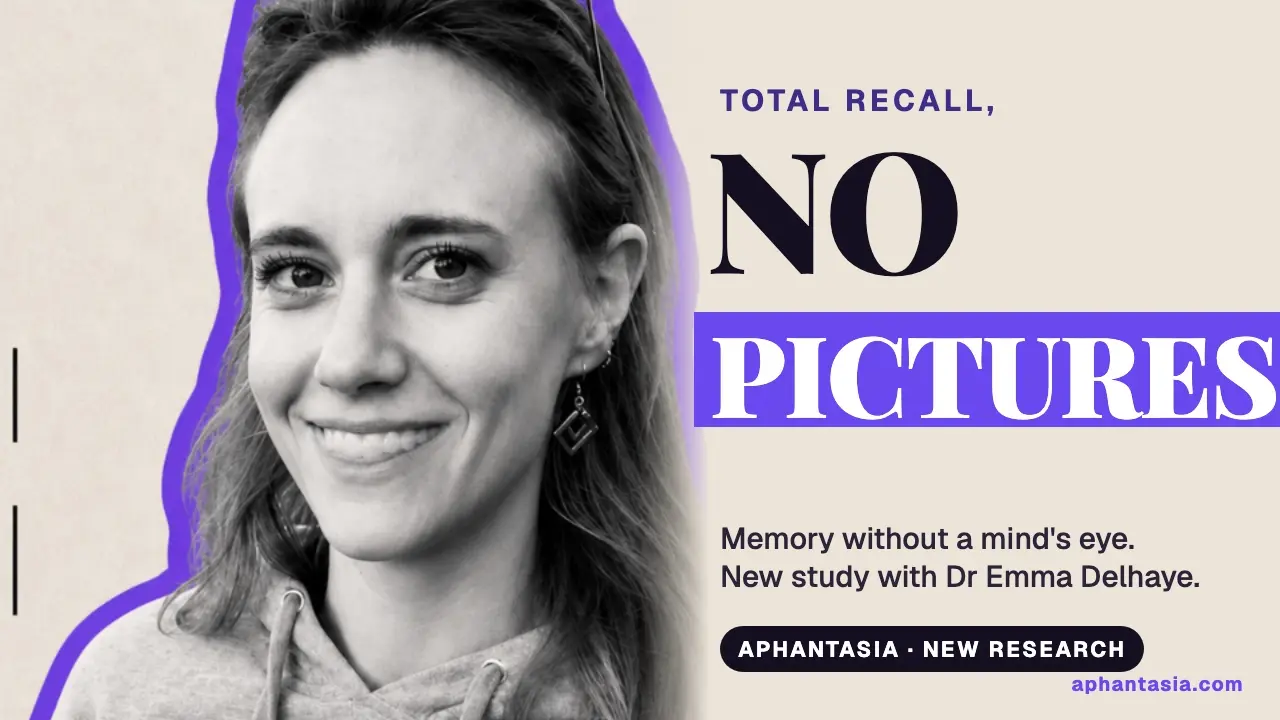
Dr Emma Delhaye, University of Lisbon
When you remember something you saw, what keeps its colour with its shape?
Memory researchers call this binding: joining separate features, such as a shape and its colour, into one object you can hold in mind. Two tools could do the joining: a mental image, or naming things to yourself.
So do you need either one?
What the study found
Dr Emma Delhaye and her colleagues tested this online, in “The role of visual imagery and verbal coding in short-term memory conjunctive binding: evidence from aphantasia”, published in the journal Consciousness and Cognition in 2026.
Of 127 people who did the experiment, 78 were included in the results: 29 with aphantasia and 49 typical imagers.
Each time, four coloured shapes appeared together for four seconds. Then people rebuilt the pairs by dragging colours onto shapes. Half the shapes were easy to name, like a square or a triangle. The other half were abstract shapes with no easy name.
Both groups did better, and felt surer, when the shapes were easy to name.
But the groups did equally well. People with aphantasia remembered which colour went with which shape as well as typical imagers did.
Even with the hard-to-name shapes, people with aphantasia scored well above chance.
The authors conclude that neither a mental image nor a name is needed for this kind of memory. They suggest the joining may happen on its own, without awareness.
They didn’t rule out other strategies, such as a sense of where things were, and hard-to-name shapes make naming harder rather than impossible. These are group results, so they can’t tell you how any one person remembers.
What you’ll take away
- What binding is, in plain words
- Why “I can’t picture it” didn’t mean “I can’t remember it” in this test
- What the study could and couldn’t rule out
About Emma
Dr Emma Delhaye is an assistant researcher in the Faculty of Psychology at the University of Lisbon. She earned her doctorate in psychology at the University of Liège, where she still works with the Aging & Memory group. She studies memory and aging: the sense that something is familiar, memory for events, and early signs of Alzheimer’s disease.