EventsTalk · Members only
A Unifying Theory of Aphantasia
Dr Merlin Monzel, University of Bonn
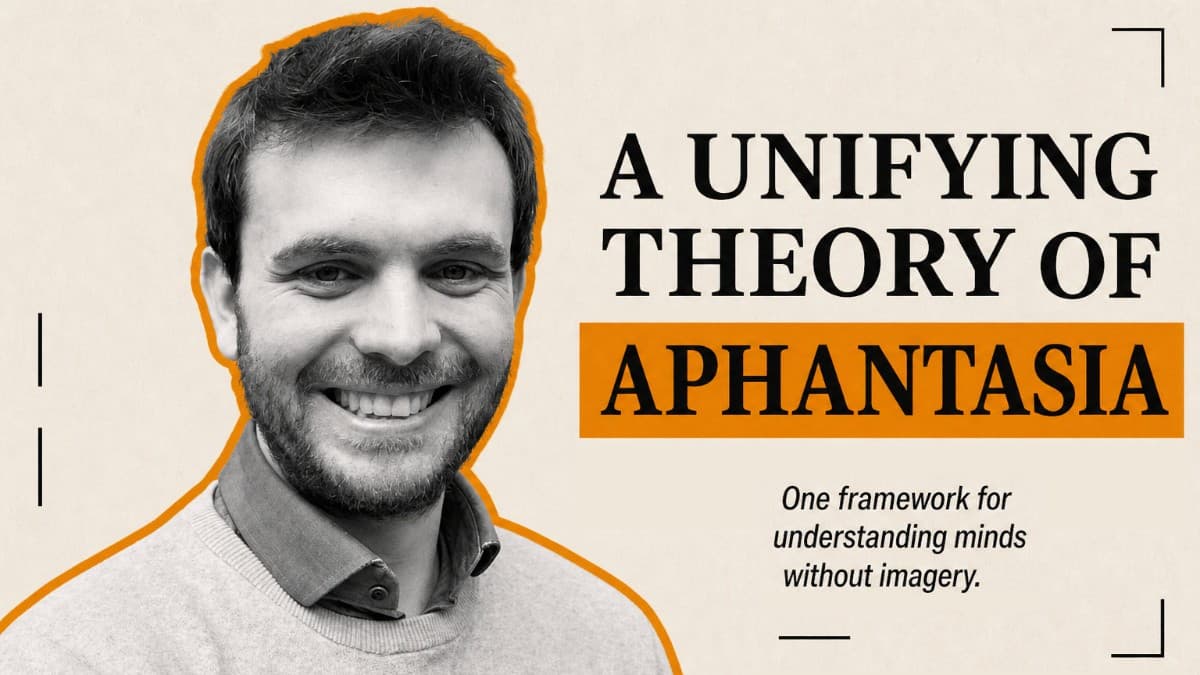
To picture something, do you first have to tune out what’s around you?
Dr Merlin Monzel thinks so. On his account, imagining depends on disengaging: turning down what the open eyes take in, and the visual brain’s own background activity, until the image is what’s left.
So could aphantasia be a difficulty disengaging from the world outside?
What Merlin talked about
Merlin set out a theory that tries to connect many findings about aphantasia through that one idea. On his account, aphantasia would be a difficulty disengaging from the outside world.
He pointed to fainter afterimages in aphantasia, the glow you see after looking at a bright light, and to weaker responses to some visual illusions, as signs that perception stays closer to what is actually there. That is his reading of the evidence.
He took up a question researchers still argue about: do people with aphantasia have images they can’t see, or do they use other strategies? He leans slightly toward other strategies, but calls himself undecided.
On emotions, he said the link with alexithymia, difficulty identifying and describing your own feelings, sits mainly with faint imagery rather than none.
On whether imagery can be trained, he described an unpublished pilot from his lab that found a small gain in self-rated imagery, and he wasn’t sure it was a real training effect rather than people learning to use the questionnaire.
He calls the theory preliminary: existing studies read in a new light, with no experiment yet designed to test it. He presented it to our community while it was still under review.
What you’ll take away
- One idea that tries to connect many aphantasia findings
- Why fainter afterimages might fit the theory
- What it would take to test the theory
About Merlin
Dr Merlin Monzel is a research associate in the Department of Psychology at the University of Bonn. He studies imagery in all the senses, aphantasia and hyperphantasia, and how the brain supports them.