What’s It Like to Be an Artist With Aphantasia?
An artist shares his surprising discovery of living with aphantasia—the inability to visualise. Despite being unable to picture faces or landscapes, he reveals how this unique trait shapes his creative journey, forcing him to work instinctively, embrace experimentation, and use photography, digital tools, and video to help translate emotion into art.
11 min readByPaul Windridge
I had no idea about aphantasia until three years ago, when I watched a YouTube video my youngest daughter made on the subject. Her passion is reading and writing, and in her research, she discovered aphantasia and became interested in how it might affect authors and readers if they couldn’t visualise. As I watched her presentation, it gradually dawned on me that I might be similarly affected, so I looked into it further.
Surprise! I Have Aphantasia!
Up until that point, I hadn’t given much thought to the fact that I can’t visualise. I didn’t think I was any different from anyone else in that respect, but it seems I was wrong. I always thought that when anyone said, “Picture it in your mind”, they meant think of it—I didn’t realise people could actually see images—that was a surprise!
I can perceive something in my mind, understand what it is, and know what I’m thinking about, but if I can’t see it with my eyes, it isn’t visible to me. With people, I remember their personalities, their characters, and possibly any really distinctive features and mannerisms. I recognise them when I see them again, but I can’t picture them if they aren’t in front of me. When it comes to places I have been, I can recall what it was like to be there, who I was with, and what we did, but I wouldn’t be able to supply you with any real detail about how the place looked.
It’s probably why I take a lot of photos wherever I’ve been and have spent so much time ensuring that I keep all the photographs from my past; I can’t picture anyone I have ever known. Without a visual reference, I would be left with a blank space.
The realisation that I had aphantasia prompted me to delve a little deeper. I discovered that I am one of an extremely low percentage of the population, and being an artist, that percentage is even lower. I then found out that some people can also recall sounds, smells, tastes, and sensations of touch. I can’t do any of that! At least I can remember and replay music in my head, so it’s not all blank upstairs. But when I dream, I do so in colour with images along with other senses. So it would seem that I can visualise when I’m asleep but not when I’m awake. In other words, when my brain is on autopilot and my body is at rest, it functions quite differently than when I’m awake and supposedly in control. Is that some kind of joke?
Knowledge Is Power
The English philosopher Francis Bacon wrote in his Meditationes Sacrae (1597), “For knowledge itself is power.”I think that’s very apt. The knowledge that I have aphantasia and that it is now scientifically recognised has already explained a lot about some of the reasons why I do what I do. It has also imbued me with a feeling of positivity tinged with a touch of amusement because I now realise that I have overcome a distinct challenge some artists like me experience without fully realising that I constantly overcame this challenge in the first place! It also helps that I have always believed that you have to embrace change in order to progress, even when that change is more than a little baffling and entirely unexpected.
How Aphantasia Has Affected the Way I Work
At school, I had a friend who could paint and draw incredibly detailed pictures from his imagination. I was (and still am) entranced by his work, but I always wondered how he could translate thought into detailed images. To me, that was magic. I always thought he was the exception to the rule, and perhaps with that amount of vivid recall, he still is, however I also thought that most other people were wired like me. He and I also went to the same art college, where we drew or painted from life and were then encouraged to develop our own concepts. He carried on as he always had, recollecting things in his imagination, and I continued to utilise photographs for inspiration.
For two decades after I left college, I made my living as a painter and had several exhibitions. I initiated the work and played by my own rules. At the time, most of my paintings were landscapes. I would visit the area I was interested in and take copious photos to work from. The photographs were then used as a reference. They were interpreted, rather than faithfully reproduced. I could have worked from a sketch book, but for some reason, I hardly ever use one.
Ironically, since moving close to the sea on the edge of some of the most beautiful scenery in the UK, I haven’t painted landscapes since I’ve been here, although I film the sea and the coast. I still walk every day on the nearby hills and enjoy being in the wild with just animals and birds for company. In 2020, I was privileged to be accepted by a pair of wild foxes whom I visited nearly every day for over four years. They allowed me into their lives and taught me their ways, so I photographed, painted, and filmed them many times.
I tend to work in the moment when I’m doing my more realistic paintings. If the painting is figurative (eg. of the foxes), it’s imperative that the finished work resembles the subject, portraying character and personality.
I make decisions instinctively as the painting process develops. I use brushes and my fingers. At first, my hand and arm movements are expressive and vigorous. Then, in areas where I want more detail, I slow down. The length of my brushstrokes becomes shorter, the pressure more delicate and considered, and there is a great deal more subtlety in my movements.
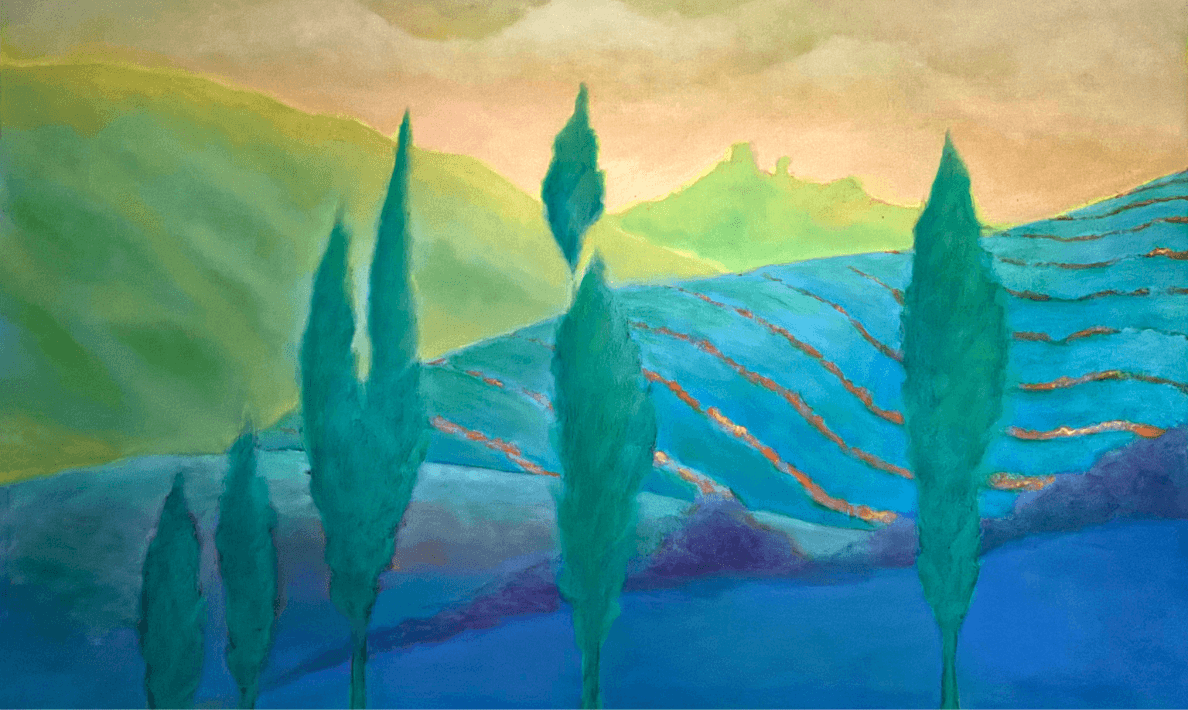
Some of my other work is more conceptual as well as figurative. I gather visual reference, work with it in Photoshop, and once I am happy with the concept, I print it out and paint from that image. For this work, I translate the digitally produced preconceived image, which will have evolved through several stages. The paint is often applied in flat areas with light shading, but there’s still a possibility I will change elements such as colour, because I don’t think the juxtaposition works as well in pigment as it did on my computer screen. The difference between digital (RGB—the colours of light) and an actual painting (pigment) can be considerable.
When I finally accept that I have taken a piece of work (in any medium) as far as I can, I live with it for as long as it takes me to either accept it or realise the need for further change. Ultimately, I may destroy the work completely and rebuild it from scratch, or I may just alter a minute detail, but I am never afraid to start over again. Most of the canvases I paint have been worked on previously—there are often two or three paintings underneath, so they all have their own history. It’s similar to moving images and music. For me, everything evolves, and the creative journey never ends.
Being An Artist Without the Ability to Visualise
This isn’t easy to explain, but I’ll try to give you more of an insight into what it’s like to be an artist without the ability to visualise. Recently, I had a notion that I should paint alternative versions of my “Interactions” paintings in a more expressionistic style. I drew them out on canvas from the original images I’d previously constructed and printed as reference. When it came to painting the images, I didn’t actually know how I wanted the end result to look because I couldn’t visualise it.
I decided a good place to start was deciding on an alternative palette of colours, then I picked up a brush and started to paint with just the thought in my head that I wanted to paint more expressively. Without any sort of clear picture of an outcome, all I could do was paint instinctively in a way that seemed comfortable.
When I assumed the paintings were finished, they didn’t look anything like what I’d expected they might. Not that I would know that because, after all, I can’t visualise. Confusing, isn’t it? Without a clear image to work from, the only thing I could do was to be true to myself—to paint the way I felt at the time, even though I didn’t know what to expect, to hopefully be relatively happy with the result. Fortunately, I was.
The whole process made me realise that my aphantasia does influence the way I work and that I have to work instinctively and spontaneously. In other words, create in the moment.
I don’t know whether I would be working in a completely different way and on alternative subject matter if I could see pictures in my head. All I can say is that the way I work has always felt completely natural to me.
My Aphantasia and Working With Digital Art Forms
When digital first entered our lives, I moved away from painting for several years. Only recently have I taken it up again. In between times, I worked with my partner as an image-maker and designer for the creative sector. We mostly designed for print and made images for arts organisations, theatres, record companies, contemporary dance, and the occasional fashion label.
After a relatively short period of time, we formed a close relationship with Adobe, which also prompted me to get involved in video and sound. For both of these disciplines, I use the same approach as before and work in my own way, learning as I go. I believe that you are more likely to make discoveries by experimentation as long as you are willing to embrace the fact that you will make mistakes and then learn from them.
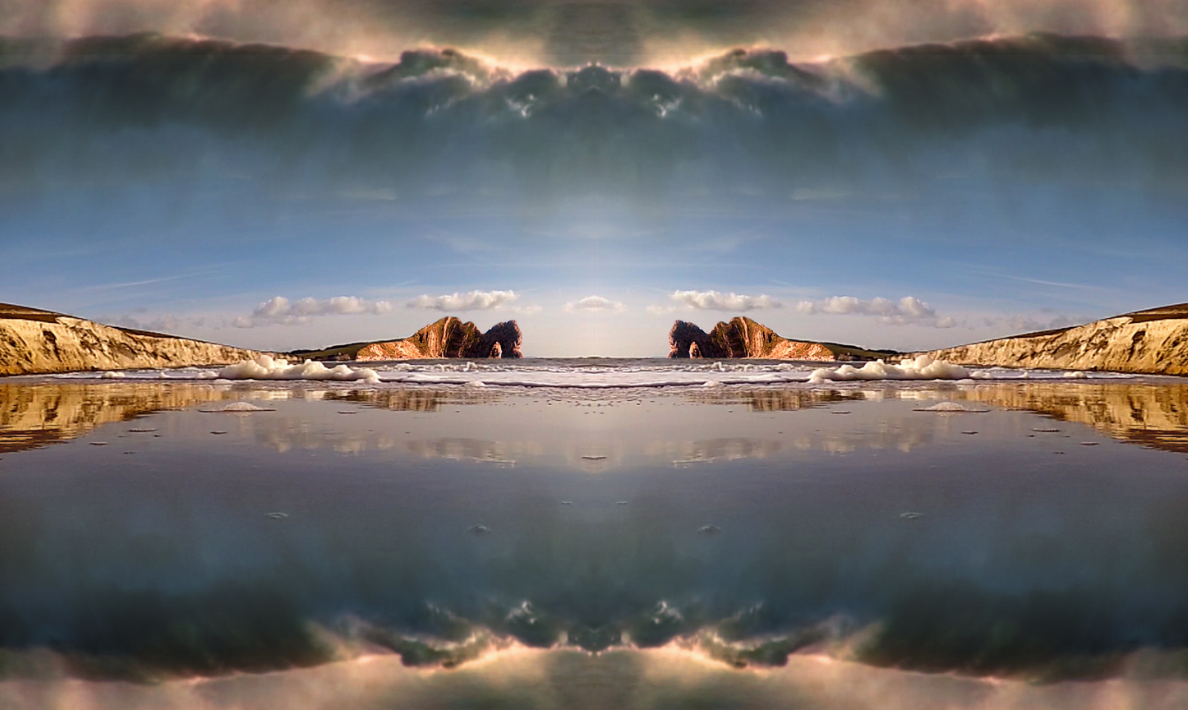
In moving images, I combine footage using layers and masks, and have a fascination for symmetry. My way is to film the everyday and turn it into something different to demonstrate that there may be more to this world than meets the eye. I am combining the world we know with an alternative reality where atmospherics, ambiguity, and mystery are important components. The result is reality and imagination combined.
Because of the inability to visualise, I have no preconceptions as to how a video will look when I start to put it together. I tend to make decisions as I go, and even after I have decided it has reached the point when I can leave it alone, I may well return to it months later and change it just as I do with almost everything I create. It’s not that I’m never satisfied—it’s more that my expectation of what might be acceptable changes over time.
I have spent a considerable amount of time creating still images, so my desire is to be able to stop one of my videos at any point and for that single frame image to be good enough to be displayed on a wall in its own right. I know this is impossible to achieve, but it doesn’t stop me from trying.
The advantage with video, as far as my aphantasia is concerned, is that I have to have shot some footage to start with, so I have that visual reference. I have created my own Mac-based library so that I have access to a variety of footage whenever I feel like experimenting.
My music-making process is similar. Everything fell into place for me when, because of digital technology, I was able to see sections of sound waves on my computer. I could then move individual soundwave sections around and arrange them in patterns of interacting layers to create melody, rhythm, and atmosphere. The visible aspect is so important in this respect because, once again, I have that starting point. I build audio and visual compositions with samples, then introduce my own sounds whenever I feel it is necessary.
My Conclusion: Advantages and Disadvantages of Having Aphantasia
Before I discovered aphantasia, and this is part of who I am, the fact that I can’t visualise or utilise any of the other senses in my head wasn’t an issue. I thought only the exceptional few could do so. It turns out that I am the exception.
I would like to have the ability to recall people and places in my mind so that I can remember the good times more vividly. But I do remember feelings, emotions, and being there, so my memories are no less poignant. For the times I would prefer to forget, I wouldn’t want to revive visual reminders anyway. Having to endure the negative emotions of those moments can be overpowering enough without the added burden of visual imagery to add to the trauma. It would be perfect to be able to turn a mind-picture switch on and off, but that’s not possible.
I can say that aphantasia hasn’t prevented me from doing what I wanted or achieving my goals, so I will just carry on regardless. Creating something from nothing will always be a complex business. For those of us without the ability to visualise, we have to find alternative ways to reach an endpoint by being inventive and adaptable.
I don’t consider aphantasia a disability. It can be a disadvantage, but I can cope with that. I have always thought that I was wired differently. Now I know that aphantasia is the reason why.
Want to see Paul's work for yourself? His "Fox Tales" project grew out of four years spent visiting a pair of wild foxes who slowly let him into their lives — captured through the painting, photography, and moving-image work he describes above. It's a beautiful example of an artist building from what's in front of him rather than what's in his head.
If you're an artist who works without visualization, we'd love to hear how you approach your craft — share your experience in the discussions.