Exporting the Invisible: How an Aphantasic Artist Creates Animated Musical Scores
When viewers encounter Stephen Malinowski's Music Animation Machine —vibrant, cascading visual scores that dance in perfect synchronization with classical music—many assume the creator must have an exceptionally vivid visual imagination. The reality is precisely the opposite: Malinowski has aphantasia.
When viewers encounter Stephen Malinowski's Music Animation Machine—vibrant, cascading visual scores that dance in perfect synchronization with classical music—many assume the creator must have an exceptionally vivid visual imagination.
The reality is precisely the opposite: Malinowski has aphantasia, the inability to visualize mental images. Yet through an iterative process he describes as "exporting" his non-visual imagination, he creates some of the most compelling animated graphical scores online, viewed by millions.
His work raises fascinating questions about the nature of creativity, imagination, and how we translate internal experience into external form. What does it mean to imagine without seeing pictures? How does an artist know when something looks "right" if they can't preview it in their mind?
You’ve used your five free reads
Members read everything here, and put their own questions to the researchers at live talks.
Every talk recorded, with the questions
The members’ Discord, between talks
The Aphantasia Explained course, with Annual
Prices in US dollars, plus tax where it applies. 30 days to change your mind.
Aphantasia Network is shaping a new, global conversation on the power of image-free thinking. We’re creating a place to discover and learn about aphantasia. Our mission is to help build a bridge between new scientific discoveries and our unique human experience — to uncover new insight into how we learn, create, dream, remember and more with blind imagination.
Was this helpful?
We spoke with Malinowski about his creative process, the discovery of his aphantasia, and how the absence of visual imagery has shaped his distinctive approach to creating musical scores.
Discovery & Understanding
When and how did you first discover you had aphantasia? Was there a particular moment when you realized your experience differed from others?
I first saw the word “aphantasia” sometime in mid-2025, but I didn’t realize it applied to me until December of that year, when I read Larissa MacFarquhar’s New Yorker article.
Reflecting on it, I recognized that I wasn’t always aphantasic: when the Soma Cube first became popular (in the mid-1960s, when I was a teenager), I would solve it in my mind when I was in bed at night. I could keep all seven shapes in mind, and saw the partially-assembled cube as I was working on it. It was pretty much the same as doing it with the real blocks while looking; the main difference was that I didn’t have tactile/spatial intuitions, and was doing it all by “seeing” the shapes, so it was a little harder. Doing this is impossible for me now—I don’t see anything if I try solving the Soma Cube with my eyes closed.
I remember, at the time, being fascinated that I could work on the Soma Cube in my mind, but I don’t remember thinking about my visual imagination after that, and didn’t notice it going away, or that it was gone, until I read the New Yorker article.
What became clearer to you after learning about aphantasia? Did it reframe or explain anything you'd noticed before?
Knowing I have aphantasia raised some possible explanations for things I’ve noticed about myself, but I’m also somewhat on the autism spectrum, and that provides equally plausible alternate explanations for many of those things. In some cases, it’s hard to say whether a limitation is the result of having a poor memory or because of aphantasia. For example, some people I know have vivid recollections of scenes from their past—they remember where they were standing, what the people around them were wearing, what was said, and can re-experience the emotions. My memories are more like “executive summaries”—a compact set of salient points, as might have been taken down by a secretary.
Before you knew about aphantasia, how did you think about your relationship with your imagination—or did you simply not think about it at all?
I’m curious about how the mind works, and I’ve pondered questions like “where do my thoughts come from?” and “do I have free will?” but I didn’t consider my experience as a special case. Ideas arise all the time, and I guess I assumed my imagination worked the same as everyone else’s.
I have a friend who was very adept at drawing 3D diagrams of mechanical objects, and when he described his process to me, I could tell that his visual imagination worked differently than mine, but I figured he was the unusual one.
The Creative Process
You've described your process as "exporting" your non-visual imagination into something visible through iteration. Can you walk us through what a typical working session looks like? How do you know when something is getting closer to what you intend?
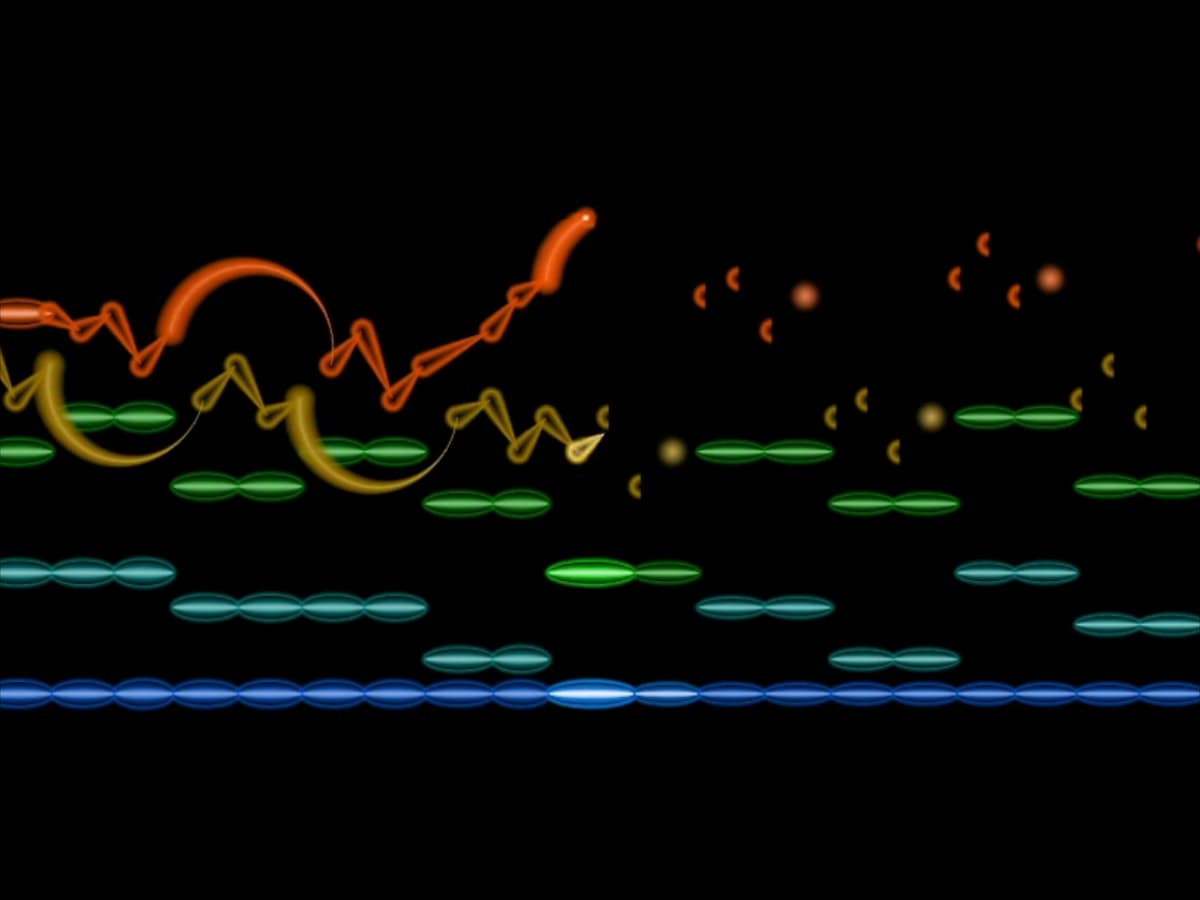
I start by making a graphical score that’s a simple “piano roll”—a scrolling image with rectangles showing the duration and pitch of the notes (like this). Watching it, I’m very aware of things in the music that I’m not seeing. For example, when there’s a melody, I know that one note is “connected” in some way to the next. Or, I know that one note is louder than another. Or that the notes of one instrument stand out over those of another.
I respond to these mismatches by changing the animation: drawing lines to connect the note of a melody, making louder notes bigger, putting prominent notes in front of less-prominent ones.
Then, I watch it again, and look for the next most-obvious mismatch, and change the animation there. I repeat this process until … hmm … it’s hard to say exactly why I stop. It’s not that I get to the point where what I’m hearing and what I’m seeing are exactly the same; I’m never anywhere near that—hearing and vision are so fundamentally different. Sometimes, it’s that I feel it’s “good enough,” and I’m tired of working on it and want to do something else. Often, though, it’s that my new ideas would require abandoning some or all of the work I’d already done and starting from scratch with a new idea; in those cases, I decide to save the new ideas for the next piece that can use them, and publish the current draft to document my work.
When you say the differences between what you see and your mental "depiction" are obvious to you—even though it's not visual awareness—what does that felt sense of "wrongness" or "rightness" actually feel like?
That’s a hard one to answer. If I’m watching somebody walking, and they’re moving unnaturally, what does the “wrongness” of their gait feel like to me? I can’t really describe it, but it’s similar to what I feel when I’m watching one of my animated graphical scores: a kind of kinesthetic sense of what’s happening visually and aurally. I have the feeling that the music is a living thing, both individually as notes and collectively as melodies, passages, movements. Listening to music (or even just hearing it in my head), there’s a feeling of “what it’s doing” … and when I watch my animations, it’s through the lens of “what is it trying to do?” And it’s clear to me, when my sense of what the animation is failing to do what the music does, that it is, in a way, disabled, either physically or psychologically.
What does your conceptual imagination give you access to? What kinds of information or qualities can you work with, even without seeing them in your mind?
I don’t know. I mean, I’ve never thought about it that way. I assumed my conceptual imagination is like everybody else’s. Maybe I still do? 99.9% of the time, ideas suggested by viewers of my videos are ones I’ve already had (and either already experimented with, or rejected as unworkable/unhelpful, or not gotten around to yet). So, I don’t think that what I’m doing is unusual; I’m just one of the few people with the necessary background to do the technical part of it (software, algebra, geometry, music theory and notation, etc.) who has nothing they’d rather be doing.
Does your process ever surprise you? Do the iterations sometimes reveal something you didn't "know" you were aiming for?
Ha-ha! You could say that it never does, or that it often does, or that it always does. I don’t know where my ideas come from (that is, until I have an idea, I don’t have it), but once they come, I can always come up with explanations of what they’re connected to that might have led to them arising. There are times I’m surprised by something being either more or less effective than I expected.
The biggest surprises, though, are of a completely different origin: when I make some sort of software mistake, and the animation does something that I very much was not aiming for. These are seldom things I keep (since I had something else in mind), but they sometimes lead me to consider possibilities of my tools that I hadn’t explored.
Auditory & Other Senses
How would you characterize your auditory imagination? Can you "hear" music in your mind, and if so, how vivid or detailed is that experience?
As a trained musician/composer, I have a good amount of musical auditory imagination. Looking at a (conventional) musical score, I have an idea of what it sounds like; how strongly I “hear” it depends on its complexity and my familiarity with the things like it. When I’m looking at a score of a new piece while listening to a recording, I try to imagine what the music that’s about to happen will sound like (and feel like); this can range from knowing almost completely what my experience will be, and hardly knowing at all.
I assume that my experience is like everybody’s but stronger than the average person’s. For example, I expect that most people can “hear” the Happy Birthday song in their head, and that my experience is just like that, but works across a broader range of music, and applies to music I’m reading from a score (the way most people can imagine a person speaking the words they’re reading in a book).
What I’m perhaps a little better at than most musicians is noticing differences between music I’m listening to and what’s notated in the score.
Do other sensory modes—spatial awareness, movement, emotional tone—play a role in how you conceptualize the music before translating it into graphics?
Most certainly. In fact, I’d say that those things are the main things that inform my work. The only word I’d argue with is “before,” since these things come into play in the process of translation. When I hear a piece of music, I have a sense that I could do something with it but, often, relatively little idea of what that would be, and I only develop an idea when I do the work.
Music & Graphical Scoring
What drew you to classical music specifically? And what about it lends itself to your approach?
I started (classical) piano lessons when I was eight, and for many years most of the music I was exposed to was what I played myself. The music visualization project grew from my relationship to scores, and scores for classical music are almost always available. I’ve done animations for other genres, styles, traditions, but only when somebody has transcribed the music into a score I can use. My approach was a result of using classical music as the raw material, and would probably have been different if I’d focused on other kinds of music.
An example: I’ve loved fugues for sixty years, and when I started making animated graphical scores, I started with fugues, and of the 1800+ videos on my main YouTube channel, over 500 are of Bach’s music, with lots of fugues. To appreciate a fugue, you need to follow multiple melodic lines at once, so one of the first things I did in my graphical scores was give each melodic line its own color, to make it easier to follow.
When did you first start creating graphical scores, and what prompted that initial exploration?
During the years when my musical horizons were starting to broaden, I spent a lot of time listening to music while following a score. I could follow piano music easily, but with more instruments in the score, it was more difficult, and I realized that my needs as a listener were different from those as a composer or performer. That led to my first hand-drawn scores.
How has your approach to graphical scoring evolved over the years? Are there techniques or insights you've developed that have fundamentally changed your work?
At first, I made piano-roll-style videos, and for many years, my experiments beyond that were completely separate (I published some of them in this). But by 2010, my orientation had shifted. This came in part from what I’d learned about human auditory processing and cognition in the work I’d been doing since 2001 as a DSP (digital signal processing) engineer. I went beyond considering music as merely abstract patterns to realizing that it was fundamentally about the subjective experience of hearing it. As a result, I was no longer content simply highlighting features of the music that were objectively present in the score, and started looking for ways to embody the animations with qualities that I felt while listening.
Your Music Animation Machine has such a distinctive aesthetic. How much of that emerged from technical constraints versus creative choices?
It’s hard to draw a line between those two things. I don’t consider myself as much a creative artist as an inventive engineer. As an engineer, my design goal is to provide something that helps a listener enjoy music more. I make aesthetic choices, but these are mostly for the purpose of eliminating distractions. I want whatever I’m trying to show to be as obvious as possible, so if something is ugly, or sticks out, I try to fix it. For example, I found that hard edges on note objects often looked ugly, and distracted from what the notes were doing, so I switched to using softer edges (This Seurat sketch was part of my inspiration for that).
Because of my focus on function, I don’t develop techniques just to look nice, or to be visually impressive. I’m not trying to make something that is pleasing to watch apart from the music. So, I’ve kept my palette simple: geometric shapes, consistent pitch-to-position mapping, simple color sets, 2D, etc. I’ve experimented with 3D, and while it sometimes gave a dazzling effect, it never contributed to the music experience, and I’ve pretty much decided that for me, it’s not worth the trouble.
So, yes, there are technical limits to what I do, but I don’t see them as constraints.
Broader Reflections
Some might assume that aphantasia would be a barrier to creating visual art. What would you say to that assumption?
I’d say that aphantasia is a factor in what a person is capable of, but that visual art can be done so many ways that to call it a “barrier” is overstating its impact. What I do is very concept-oriented, and I can do my work without a visual imagination, but I know of artists with aphantasia who are doing more conventional “visual art” at a high level. Would they be better without aphantasia? Hard to say. There are lots of factors that can limit what an artist can do, and it doesn’t seem like aphantasia is more of a barrier than numerous other things that artists regularly work around.
Do you think having aphantasia has shaped your work in ways that make it distinctive or unique? Or do you see it as simply one aspect of how you work?
It almost certainly had some effect, but it’s hard to guess exactly what that might have been. My work might go faster if I could imagine what something would look like without having to make it, and I often have to make sketches to get an idea into a form where it’s easy to convert it to software, but would I be more imaginative if the things I now imagine without mental imagery were instead visible? I don’t know.
What do you hope people take away from experiencing your animated graphical scores?
I hope my videos help people enjoy the music, and I especially hope that they help people appreciate things in music that they wouldn’t have otherwise been aware of.
How would you recommend people learn about your work?
The reality is precisely the opposite: Malinowski has aphantasia
His work raises fascinating questions about the nature of creativity, imagination, and how we translate internal experience into external form. What does it mean to imagine without seeing pictures? How does an artist know when something looks "right" if they can't preview it in their mind?
Image-Free Insights
A short note from our founder, Tom Ebeyer, every other week, plus occasional news and invitations to take part in studies. Change what you get from any email.
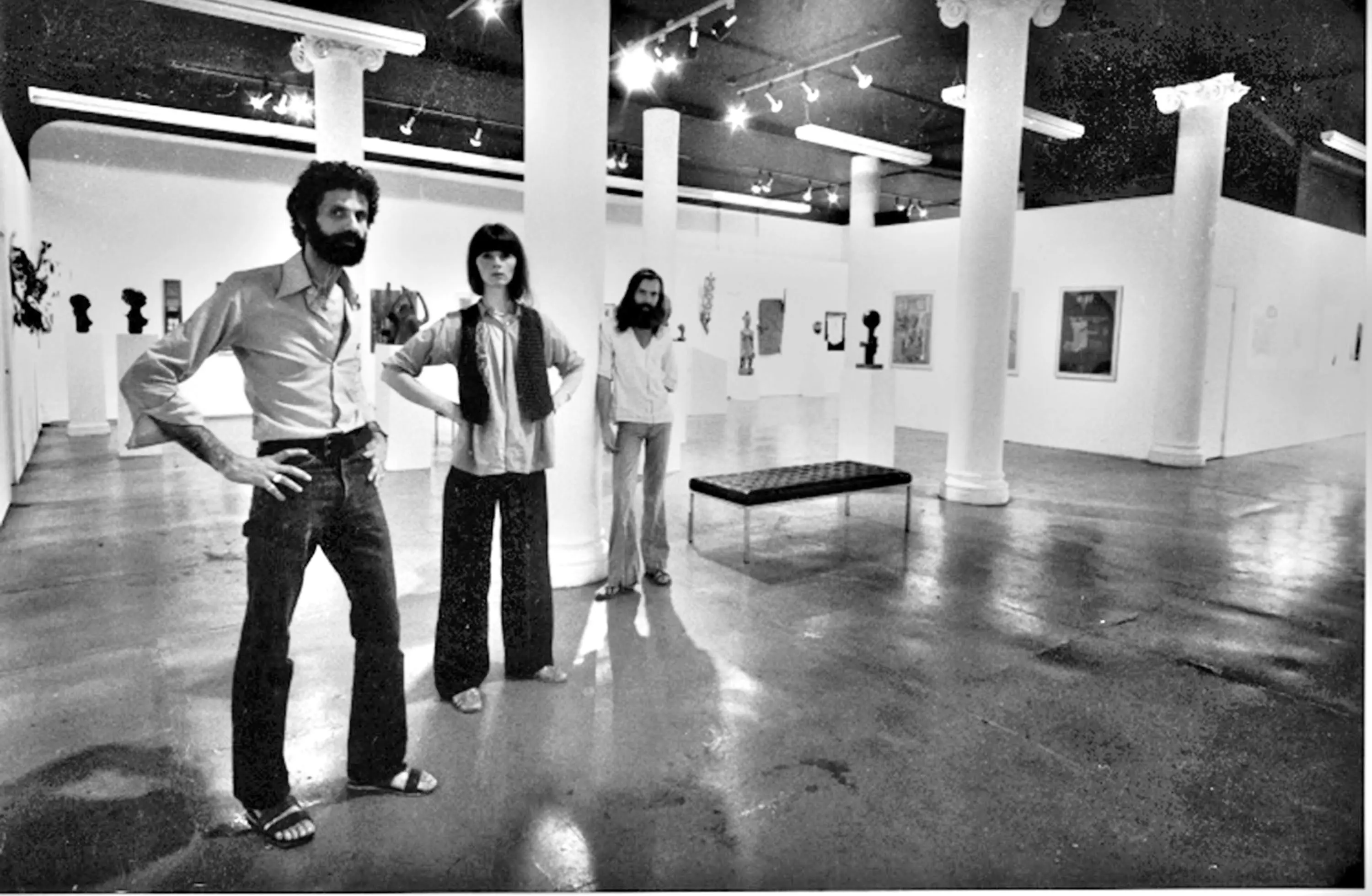
At 85, an artist and curator discovers aphantasia and finally understands decades of struggle with art school instruction, finding that a tactile "add and subtract" method, first in assemblage, then photography and curating, was the workaround that quietly shaped an entire career.
Geno Rodriguez · October 2026
The Empty Canvas in My Head
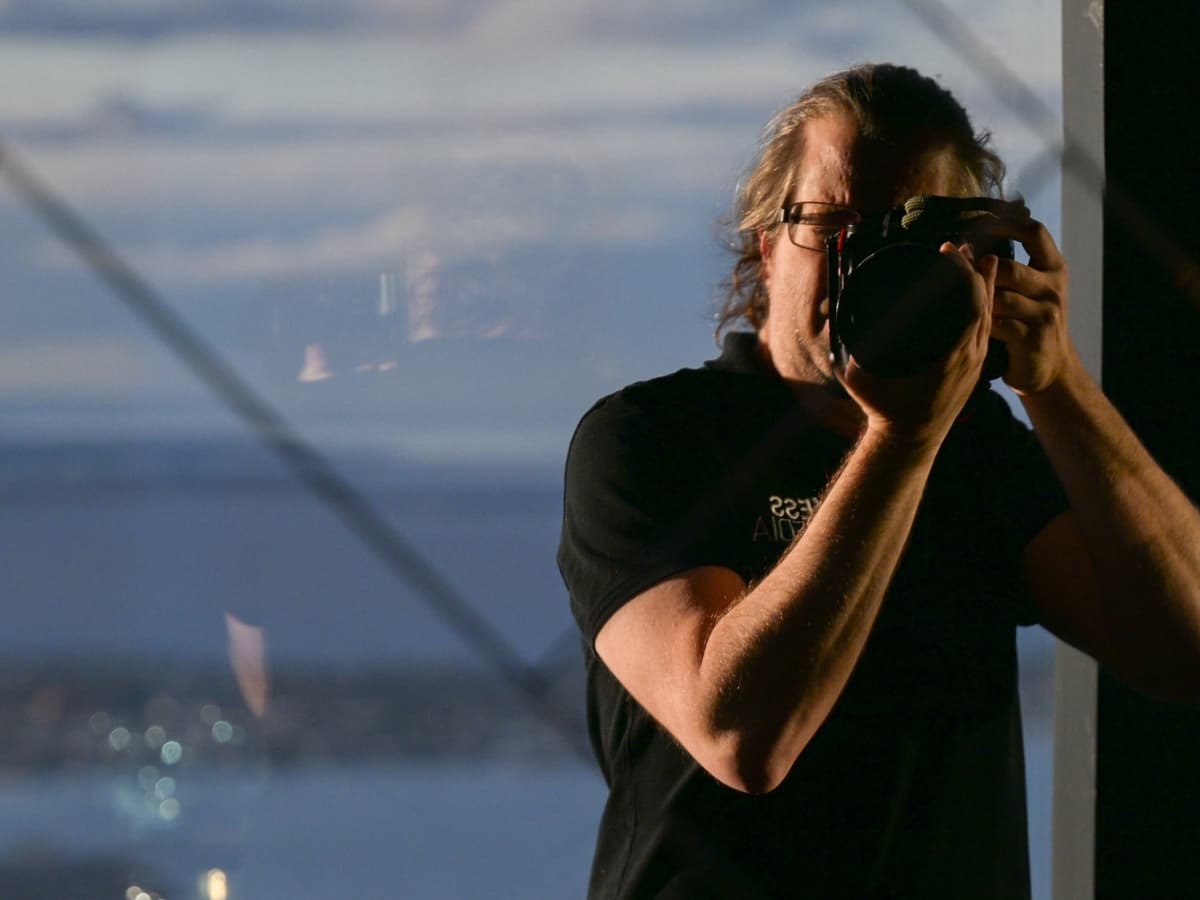
After decades behind a camera, a photographer learns his mind has never produced images, a discovery that explains his compulsive archiving, his instinctive way of shooting, and his lifelong habit of trusting what's in front of him over what's in his head.
Alexander Kesselaar · September 2026
‘That’s Not How I Pictured It’ – Why Book‑to‑Film Adaptations So Often Disappoint
Film adaptations and illustrations can clash with our personal mental images. However, for those with aphantasia, who cannot mentally visualize, these on-screen adaptations offer a uniquely liberating way to experience stories.