EventsTalk · Members only
The mind’s eye in the witness box
Dr Heather Kleider-Offutt, Georgia State University
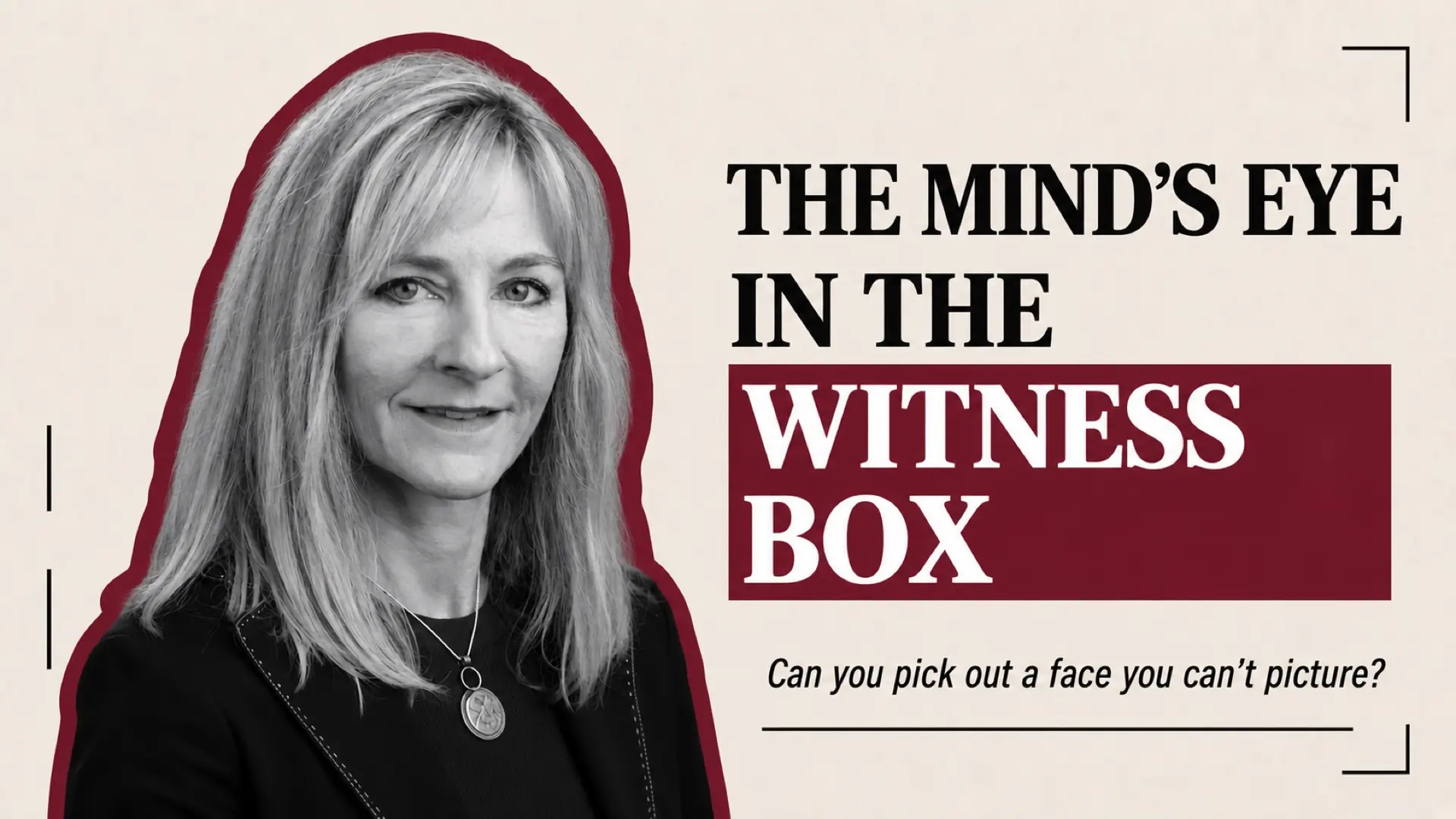
Could you pick a stranger out of a line-up if you can’t picture their face?
After a crime, police ask witnesses to describe the person they saw. For most people that is thought to backfire: putting a face into words can make it harder to recognize later, a pattern called verbal overshadowing.
But what happens when your memory of a face was never a picture to begin with?
What the study found
Dr Heather Kleider-Offutt and Ashley Meacham at Georgia State University showed 323 people three short videos of a crime. After each one, half of them described the person who did it and the rest did simple sums. Then everyone tried to pick that person out of a line-up of six faces. Sometimes the right face wasn’t there at all.
16 of the 323 had aphantasia, 275 had typical imagery and 32 had very vivid imagery.
Describing the face didn’t hurt anyone. On average it helped all three groups.
It helped the aphantasia group most. They chose correctly in 46% of line-ups after describing the face, against 33% when they hadn’t.
Heather’s newer work asked people how they did it. Those with aphantasia said they leaned on a sense of awareness and on facts they had stored, rather than on an inner voice.
Only 16 people with aphantasia took part, so the authors call this a pattern to test in a bigger group, not a settled result. These are averages, so they can’t tell you how any one person remembers faces. The study is published in Psychology, Crime & Law (2026).
What you’ll take away
- Why putting a face into words may help you rather than hurt you
- What happens in a line-up when there is no picture to compare
- Words for the next time someone says your memory for faces can’t be trusted
How the hour runs
Heather presents “The ‘Mind’s Eye’ in the Witness Box: The influence of Imagery Ability on Face Recognition” in plain words for about half an hour, then takes members’ questions live. How do you recognize someone you know, if not by picturing them?
The talk is for members. Register on this page and we’ll email you the link. Members keep the full recording, with every question, and a shorter cut goes on YouTube afterwards.
About Heather
Dr Heather Kleider-Offutt is an associate professor of psychology at Georgia State University, where she chairs the Cognitive Sciences program. She studies memory for faces and events, eyewitness accuracy and bias in legal decisions, and she serves as an expert witness on eyewitness identification cases.