EventsTalk · Members only
Is aphantasia one thing, or many?
Bence Nanay, University of Antwerp
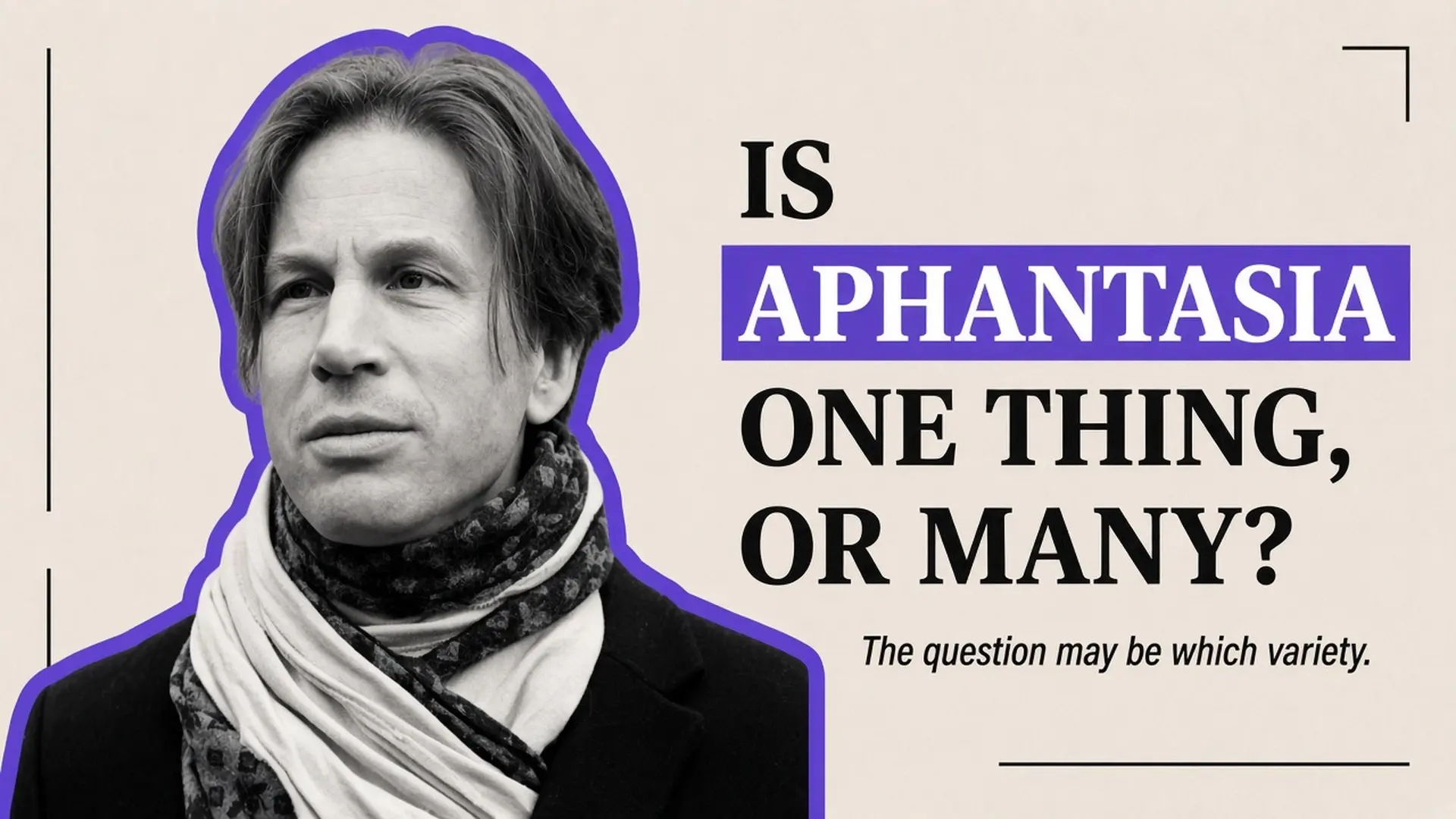
Were you handed one word for your mind?
Most people here were told it names one condition. Bence Nanay’s work says that is probably wrong. There are varieties of aphantasia: different minds that give the same answer when asked whether they can picture something.
So which variety are you?
What the work says
Bence is a philosopher who studies mental imagery. In two short papers in 2025, in Trends in Cognitive Sciences and Neuropsychologia, he argues that asking people about their imagery groups together very different minds.
Some people still have pictures in dreams or flashbacks but can’t call one up at will. Others have no conscious imagery at all. He names the two after the parts of the brain likely to differ: prefrontal and occipital aphantasia.
Some lack imagery in one sense and not others. Most people with aphantasia keep their sense of where things are in space; a few lose that too.
The causes may differ too, which makes “which variety?” a better question than “do you have it?”
He also asks us to look at the whole spectrum, from people who picture nothing to people who picture vividly, rather than setting aphantasia against “normal”. Imagery varies a lot even among people who call themselves typical.
These are arguments built on other people’s studies, not a new experiment. Bence says his list of varieties is incomplete, and nobody yet knows how the varieties relate to each other.
What you’ll take away
Why “do you have aphantasia?” may be the wrong question
The varieties, in plain words
What sits between picturing nothing and picturing vividly
How the hour runs
Bence presents his work in plain words for about half an hour, then takes members’ questions live. Which variety would you say you are, and how would you check?
The talk is for members. Register on this page and we’ll email you the link. Members keep the full recording, with every question, and a shorter cut goes on YouTube afterwards.
About Bence
Bence Nanay is Professor of Philosophy and BOF Research Professor at the Centre for Philosophical Psychology, University of Antwerp. He wrote Mental Imagery: Philosophy, Psychology, Neuroscience (Oxford University Press, 2023).