How Do You Hypnotise Someone Who Can't Visualise? Inside Aphantasia and Hypnosis
Most hypnotherapy quietly assumes a mind's eye. Dr Paulina Trevena — a hypnotherapist who discovered her own aphantasia mid-session — has spent years proving that assumption wrong, and rebuilding the practice for minds that don't picture anything at all.
Dr Paulina Trevena was in her late forties, sitting in a psychotherapy session, when she found out her mind worked differently from almost everyone else's.
The therapist had been guiding her back through her childhood, asking her to recall meaningful events. Paulina drew a blank. So the therapist tried a different route: Can you remember your childhood home? Paulina could — roughly where it was, more or less the layout. Imagine yourself in the living room. What can you see?"Nothing," Paulina said. What about the kitchen — go there. What do you see?"Nothing." By now she was wondering what on earth this woman was on about.
Then came the question that has become a kind of folk ritual in the aphantasia community. "Can you picture an apple...?" Paulina scoffed. "Of course not," she said. "Who can?"
"How about 99% of the population?"
She went home and posted the apple question on Facebook, half-certain her therapist was deranged. Most people replied immediately: Yeah, it's red, it's green, sure. The therapist was right. And by an extraordinary coincidence — in 2018, years before most clinicians had heard the word — that therapist happened to be aphantasic herself, which is the only reason she recognized what she was looking at.
For Paulina, the discovery wasn't a crisis. "I've always been different one way or another," she told Aphantasia Network founder Tom Ebeyer in this conversation. "So this is just one of my many differences." What she couldn't fathom was the other side of it — that people genuinely see images, "like on a computer screen," inside their heads. That part she still couldn't quite get her head around.
It wouldn't fully land as something that mattered until a few years later, when she walked into a hypnosis training and discovered that almost every technique in the room had been built for a mind she didn't have.
From Scooby-Doo to the Clinic
Paulina's route into hypnosis was nothing she'd planned. Before COVID, her only association with the word was cartoon villains — swirly eyes, swinging watches, people clucking like chickens. Then lockdown arrived, she's social by nature, and being shut in at home knocked her off balance. Looking for something to steady her mind, she found an online course built around positive thinking, run by a hypnotherapist who wove in hypnosis and NLP techniques.
She went in with no expectations and total openness — and during one group session, something happened that she still describes with a kind of startled wonder. The exercise was "parts work," calling in a part of herself that felt lonely, following a script into an imagined garden with a bench. And there, she says, a younger version of herself appeared. "I swear I could actually see it."
It shook her so badly she avoided going that deep again for a while — but the researcher in her was hooked. How the heck does that work? She started taking short courses, then committed to full training. And that's when the second discovery hit: she was, by the standard measures, a terrible hypnotic subject. Technique after technique that worked beautifully on her classmates simply did nothing for her.
This is worth pausing on, because it reframes what hypnosis even is. As Paulina explains it, hypnotherapy is the clinical application of hypnosis — using a focused state to help someone overcome an emotional issue. It is not mind control. You keep your free will the entire time; you can accept a suggestion or disregard it. What the process actually does is quieten what practitioners call the critical factor — the analytical, logical, self-criticizing part of the mind — so a person can work directly with emotion and shift how they perceive an event, a feeling, or themselves. The trance state itself, she notes, sits close to the brainwave territory of falling asleep or waking up.
Which raises an obvious question about that first vivid experience. Was it really visual? Paulina thinks it was — and the explanation she and Tom arrive at is one of the most interesting threads in the whole conversation.
Imagery That Slips In Through the Side Door
Many aphantasics report that imagery they can't summon on demand will surface anyway — in dreams, or in the drowsy hypnagogic and hypnopompic states on either side of sleep. Paulina, who is hyperphantasic in her dreams despite being completely aphantasic when awake, sometimes gets visuals flashing up in deep hypnagogic states, seemingly shaped by sounds around her.
Tom's experience runs the other way, and the contrast is illuminating. He doesn't report visual dreams the way most people do; his dream consciousness is "still very much monologue." Yet he'll respond to visual cues within a dream — registering a "nice orange sweater" — without any conscious image of it. The one time in his life he felt he caught a genuine glimpse of imagery came after a long stretch of experimenting with binaural beats in his mid-twenties: a faint, low-resolution flicker, "like a drop of water in a pond," that dissolved the instant he focused on it.
That dissolving is the key. Paulina describes the same thing: "The moment I gain awareness that it's happening, that's when it just fades away." It behaves like a bottom-up process — the image gets produced, but the act of consciously, analytically attending to it shuts it down.
Tom drew the connection that makes this matter for therapy: it's the same dynamic as hypnosis itself. The harder you think about producing the image — the more you engage the rational, problem-solving mind — the more it retreats. The two systems seem to compete for the same conscious space. Which means asking an aphantasic to try harder to visualize is almost guaranteed to backfire: you're switching on the very faculty the whole process is meant to switch off.
"It's Not Just About Visualisation"
The deeper Paulina got into the work, the more she realized aphantasia was only the entry point. She is a global aphantasic — no internal imagery in any sense, not just the visual — and she also has SDAM (Severely Deficient Autobiographical Memory) and ADHD, a cluster that turns out to be common.
This matters enormously for therapy, because therapy leans on mental imagery far more pervasively than most people notice, and not only the visual kind. Regression techniques ask you to travel back in time. Future pacing asks you to vividly imagine yourself six months from now, having achieved your goal — seeing it, feeling it, ramping up the emotion. Other techniques ask you to feel into the last time you were confident and amplify the sensation. For someone with access to all their internal senses, these work, and they work powerfully. For someone like Paulina, they hit a wall.
She's careful about the variation here, because it's central to her whole argument. Aphantasics who retain one internal sense often cope far better with guided imagery — she worked with someone who couldn't picture a ladder but could feel it vividly through a strong sense of touch. She suspects, without yet having the research to prove it, that people with access to other internal senses may also reach autobiographical memory more easily, triggered by a remembered voice or smell. Global aphantasics, by contrast, seem to process memory along entirely different routes.
Tom captured the global-aphantasic version of future pacing precisely: ask him to picture himself in sixty days, ten pounds lighter, and "that's it — that's the idea, we just said it. There's no sensory, there's no mental time travel, there's no ability to perceive myself in that state." The concept is fully available. The simulated experience simply isn't.
And here Paulina makes her sharpest clinical point. When you ask an aphantasic to strain after an image they can't form, you don't connect them to an emotion. You hand them a hurdle to jump over — and worse, you switch their analytical mind back on, which is the exact opposite of what hypnosis is trying to achieve. "Why," she asks her fellow practitioners, "would you ask them to do something they can't do well, when the whole reason we're using these techniques is to connect somebody with an emotion?"
Rebuilding Hypnosis Around the Body
So Paulina rebuilt her approach from the ground up, moving toward what's kinesthetic and somatic — and away from imagery altogether unless a client is genuinely open to it.
The standard induction — the on-ramp into a hypnotic state — is often visual or sensory in ways that exclude her clients: walking down imagined steps, or feeling an arm stiffen into an immovable metal bar. (Paulina's internal response to the stiffening-arm suggestion is a flat "yes I can move it," because she has no internal sense of movement to engage.) Instead, she works with the breath, and with sensations clients can actually feel in the body right now.
Her reasoning is elegant: hypnosis, stripped to its essence, is simply a state of intense focus. When you focus hard enough on anything, the critical mind stops questioning because it's too occupied — and that's the doorway through which positive suggestion becomes possible. Mental images are one popular way to reach that focus. They are not the only way. The breath, the body, the present moment all lead to the same place.
One technique she leans on heavily is parts work — the same approach behind that first vivid garden experience. The idea is that we develop distinct parts of ourselves over a lifetime. Some form through ordinary learning: the confident drive" part that runs automatically once driving becomes second nature. Others form through a single charged moment — a phobia, say, where the brain wires spider equals danger during a frightening event, even if the spider had nothing to do with the fear. Hypnosis works with those parts directly.
Tom seized on what makes this powerful well beyond the clinic. "It's a part of you — but that means it's not all of you. You are not the phobia." Reframing a fear or a limiting belief as one small, changeable part of a person, rather than their whole identity, is a genuinely liberating way to think about change. And it underscores the throughline of the entire conversation: there is nothing magical about the mental images themselves. They're just one well-worn path to focus. Take them away, and other paths remain wide open.
Want to learn these techniques yourself?
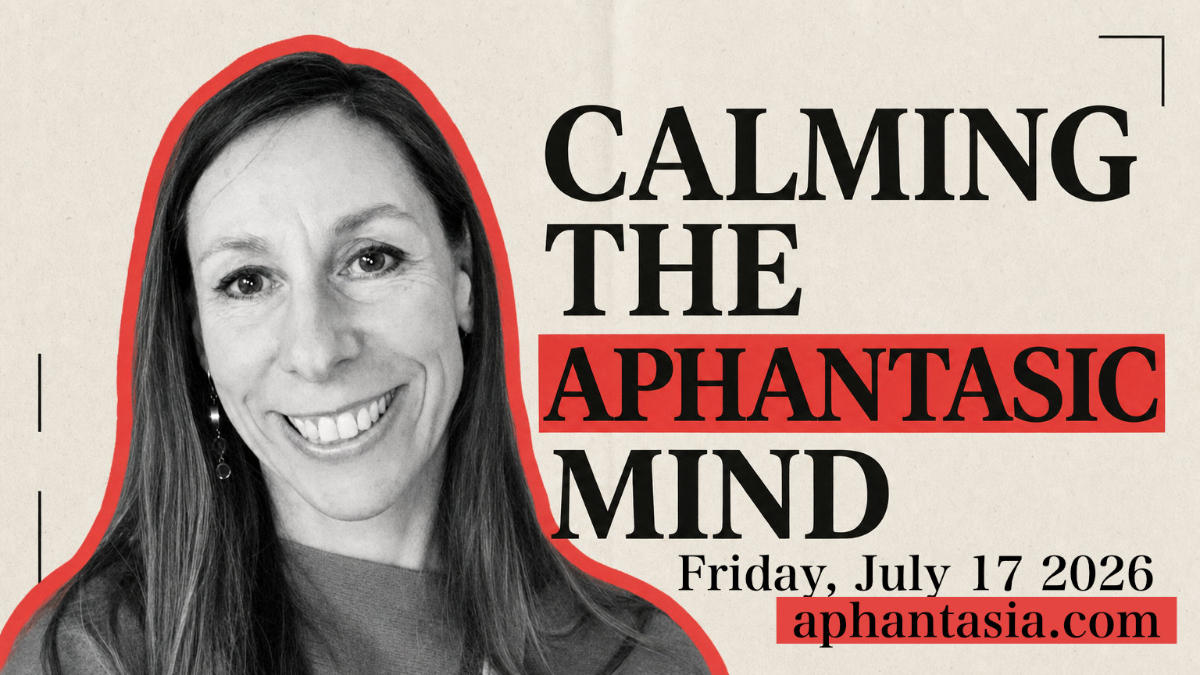
Paulina is hosting a live workshop with the Aphantasia Network — Calming the Aphantasic Mind — on Friday 17 July 2026. A practical, non-visual approach to stress and anxiety, built for minds that don't visualise. Recording included. Aphantasia Network members get 10% off.
The most human part of Paulina's story is how close she came to walking away.
Early in her training, when technique after technique failed on her, she didn't yet have the explanation. "Maybe I'm just difficult," she remembers thinking. "People are saying I'm difficult — maybe I'm difficult." Discouraged, she fell off the wagon and stopped training, half-convinced hypnosis just wasn't for her.
What pulled her back was finding the right teachers — a hypnosis academy whose trainers, once they understood her aphantasia, stayed genuinely curious about her experience rather than dismissing it. On a live online course with around eighty participants, they'd run a demo and then ask, "Paulina, how was this for you?" And she'd answer honestly: meh, didn't really work. That honesty cracked something open. Other participants began messaging her privately: I'm the same. Oh my god, I thought I was the only one.
That was the turning point — the moment "maybe I'm difficult" became "there are more of us, and we're all hitting the same wall."
Not every professional was so open. At her first conference, probing hypnotherapists about aphantasia, she met flat denial — people insisting it couldn't be real, that she was blocking it, that it was childhood trauma, that she was making it up. One NLP (Neuro-Linguistic Programming) trainer simply refused to believe her: "But everybody can visualise." Then came the famous trap question — what colour is your front door? — deployed as if knowing the answer proved she must be picturing it.
Tom has a name for this: the visualizer's fallacy. "Because this is how they answer questions, how their process works, they think everybody must use the same process." You can know the colour of your front door perfectly well as a fact, with no picture attached at all. The assumption that knowledge requires an image is exactly the blind spot the field keeps tripping over.
The Hyperphantasic Room
Paulina eventually turned her frustration into a mission — and stumbled onto a structural reason the misunderstanding runs so deep.
Every time she gives a talk to hypnotherapists, she starts by scoping the room for mental imagery: the apple question first, then a richer walk through an imagined orchard to test the other senses. The first time she did it, she was stunned. Roughly a quarter of the room experienced hyperphantasia — able to conjure the apple as vividly as real life. And it has happened at every talk since.
Suddenly a lot made sense. The profession is disproportionately populated by extraordinarily vivid visualizers — which is partly why so many hypnotherapy techniques are built on visual processes, and why the assumption that everyone can picture things is so stubbornly entrenched. For a gifted visualizer, these techniques produce amazing results; it's hard to imagine anyone experiencing the world otherwise.
But vivid imagery, both Tom and Paulina are quick to note, is no unalloyed gift. Paulina once worked with a hyperphantasic client tormented by images of her child with a slashed throat, appearing in the middle of the night as vividly as reality — a level of involuntary intrusion that would, in Paulina's words, "really throw me off." Tom has grown wary of the tidy "computer screen" analogy for exactly this reason: a screen implies control, but for many people the images arrive uninvited and won't switch off. We still understand surprisingly little about how much of the imagery experience is voluntary versus involuntary, and it clearly varies enormously from person to person.
Paulina, who discovered her ADHD a few years after her aphantasia, put it with characteristic humour: "Thank goodness I don't have those images on top — I have so many thoughts already."
Different Pathway, Same Destination
If there's a single message Paulina wants aphantasics to carry away, it's that the difficulty isn't really in them.
In the Facebook community she runs, she watches people arrive distressed — convinced they're missing something essential, gripped by a kind of FOMO about the inner life everyone else seems to have. "It's because of the environment, and because of other people not understanding how we think." The barrier is a lack of awareness and understanding, not a lack of capacity. She has met too many aphantasics who tried therapy repeatedly, were told only to "visualize this, visualize that," and concluded the failure was theirs.
Tom returned to a theme that runs through nearly all of the Network's work: it's easy to romanticize mental imagery — to imagine it as the engine of all creativity, the magic that lets you conjure a richer future self. But imagery is a double-edged sword, it isn't all upside, and you're not fully in control of it. More importantly, your beliefs about what you can't do become self-fulfilling. There are alternative pathways to hypnotherapy, to therapy, to virtually every career that supposedly requires a mind's eye — and people are quietly succeeding along all of them.
Paulina is one of them. The rebel in her, she admits, is part of what got her here: the moment professionals started questioning her own internal experience and telling her things about her mind that simply weren't true, she got annoyed enough to climb on stage the next year and start teaching them otherwise. "It's not a question of we can't," she says. "It's a question of we need the right tools. We need people to understand."
The destination — calm, confidence, the resolution of a fear, real change — turns out to be reachable by more than one road. Sometimes the path just looks a little different. That doesn't put it out of reach.
Learn More
Dr Paulina Trevena (PhD) is a certified hypnotherapist, ADHD coach, and researcher with lived experience of aphantasia, SDAM, and ADHD. A social scientist by background, she left a long academic career to train in hypnotherapy — and, after running into aphantasia as a barrier in her own training, began researching aphantasia and hypnosis. She now speaks internationally, trains other hypnotherapists on working effectively with non-visualizers, and runs her practice, No Woo Woo.
We host live conversations like this one every month — a chance to bring your questions directly to the researchers and practitioners studying aphantasia, and to connect with a global community of people who understand. Join us here.
Dr Paulina Trevena was in her late forties, sitting in a psychotherapy session, when she found out her mind worked differently from almost everyone else's.
The therapist had been guiding her back through her childhood, asking her to recall meaningful events. Paulina drew a blank. So the therapist tried a different route: Can you remember your childhood home?
Then came the question that has become a kind of folk ritual in the aphantasia community. "Can you picture an apple...?"
You’ve used your five free reads
Members read everything here, and put their own questions to the researchers at live talks.
Every talk recorded, with the questions
The members’ Discord, between talks
The Aphantasia Explained course, with Annual
Prices in US dollars, plus tax where it applies. 30 days to change your mind.
Aphantasia Network is shaping a new, global conversation on the power of image-free thinking. We’re creating a place to discover and learn about aphantasia. Our mission is to help build a bridge between new scientific discoveries and our unique human experience — to uncover new insight into how we learn, create, dream, remember and more with blind imagination.
Was this helpful?
Image-Free Insights
A short note from our founder, Tom Ebeyer, every other week, plus occasional news and invitations to take part in studies. Change what you get from any email.