Pictures Without Mental Pictures: How Aphantasia Is Rewriting a 50-Year-Old Theory of Memory
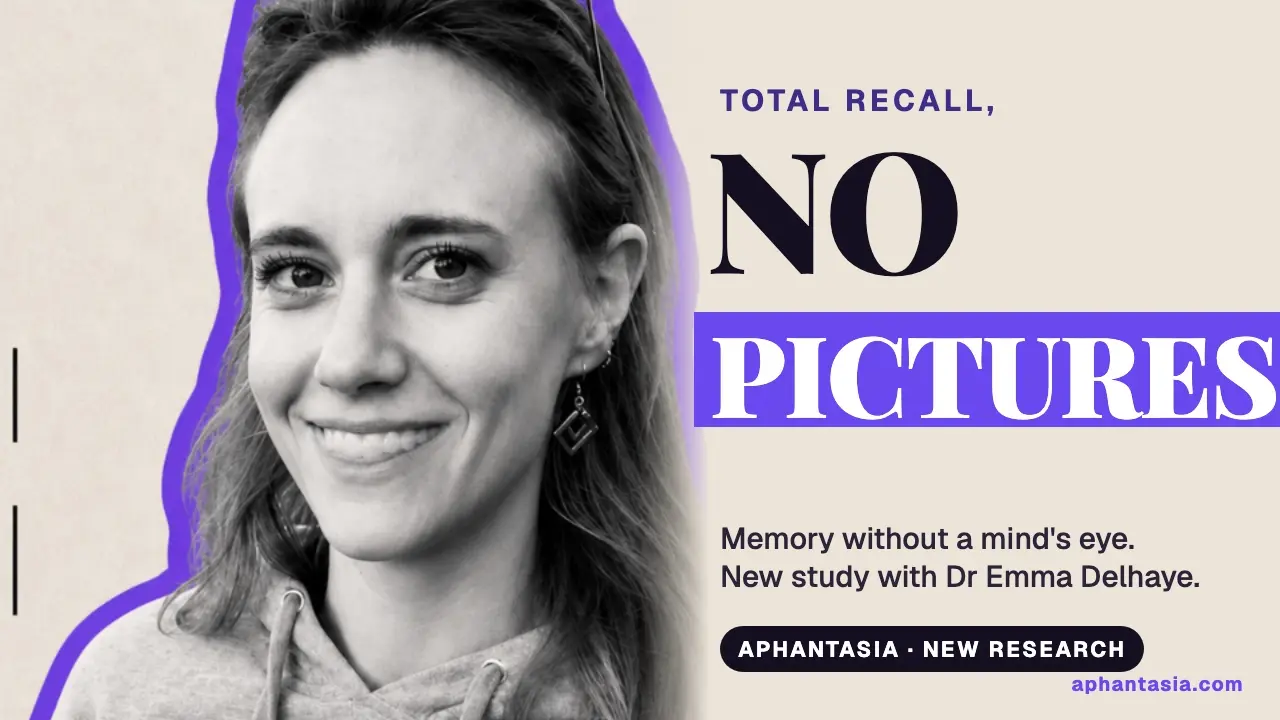
New research from Wilma Bainbridge and her team at the University of Chicago reveals that people with aphantasia still remember pictures better than words—a finding that upends one of psychology's most influential theories about how memory works.
When Wilma Bainbridge met a grad student studying aphantasia at the Vision Sciences Society conference, neither of them knew the encounter would lead to research that challenges a half-century of thinking about human memory.
"I had been doing work on using drawings to look at what's in people's memories and when we met each other we were like, whoa, what you're doing is so cool," Bainbridge recalls. "I was curious, what would aphantasic individuals draw from memory?"
Bainbridge, an associate professor of psychology at the University of Chicago, has spent the past six years studying what we remember and why. Aphantasia, she says, has been "a perfect lens" to examine what memories actually look like—because people with aphantasia "might have memories that look fundamentally different from those without aphantasia."
Her lab's latest findings don't just tell us something about aphantasia. They dismantle one of the most well-known theories in memory research.
What Is Dual Coding Theory?
There's a well-established phenomenon in psychology called the picture superiority effect: people tend to remember images better than words. You'll remember a photograph of a beach scene more easily than the word "beach."
One of the most influential explanations for this is dual coding theory, proposed roughly 50 years ago. The idea is straightforward.
"When you see a picture of a beach, you have the visual information, but you also have the name, the linguistic or semantic information, you have the word beach that pops in your head," Bainbridge explains. "So the idea here is that people can use two ways to access that memory."
You can retrieve that beach vacation through the visual route—remembering what it looked like—or through the language-based route, remembering the word "beach." Two codes, two pathways to the same memory. But if you only saw the word "beach," you only have one code. One route in. That, the theory says, is why pictures are easier to remember.
The hypothesis for aphantasia seems obvious: if you can't visualize, you can't use that visual code. No dual coding. No picture superiority effect.
"If dual coding were accurate, then indeed you would think that individuals with aphantasia would not have this picture superiority effect because they don't have that visual code," Bainbridge confirms.
Except that's not what happened.
The Study That Broke the Theory
The experiment itself was straightforward. Bainbridge's team recruited both aphantasic and non-aphantasic participants for a memory task. In some blocks, participants saw a series of pictures—a cat, a robot, a cake. In other blocks, they saw the corresponding words. After an unrelated distraction task (categorizing tones as high, low, or medium), participants were asked to write down everything they remembered.
"First we did replicate the picture superiority effect. People with typical imagery remember the pictures better than the words," Bainbridge says. "But the surprising thing is we also replicated it in people with aphantasia. So people with aphantasia also remember the pictures better than the words."
People who can't visualize still remember pictures better than words. The finding strikes directly at the foundation of dual coding theory.
"These results show us that dual coding theory cannot stand as it is because individuals without that visual trace are still showing the picture superiority effect," Bainbridge says. "Thanks to individuals with aphantasia, we've sort of disproven this really long-standing psychological theory."
The Symbol Clue
But the study revealed something even more curious.
Bainbridge's postdoc Brady Roberts had previously discovered what he calls the symbol superiority effect—people remember symbols (like $, @, and %) better than the words they represent. You'll remember the dollar sign better than the word "dollar."
This effect held for both groups. But a key difference emerged between people with and without aphantasia.
"For visualizers, they remembered the picture of dollars, the dollar sign about equally well and remembered those better than just the word dollar," Bainbridge explains. "But for non-visualizers, they remembered the dollar sign the best. Then second best was a picture of money and then worst would be the word dollar."
Something about symbols gave aphantasic participants a particular edge. And one of the researchers had a theory about why.
Motor Imagery: A Different Kind of Code
The student who ran the entire study, Hannah Yan, has aphantasia herself—scoring 16 on the VVIQ, the lowest possible score.
"It was really fun running the study with her because we kept asking her insights or asking her predictions," Bainbridge says. "And she was a pilot subject and showed exactly the results we found in our whole sample."
When they asked Yan why she performed so much better on symbols, her answer was revealing: she used motor imagery. She imagined herself drawing the stimulus.
"She could imagine herself drawing the dollar sign, but she can't imagine herself drawing this complex picture of money on a table," Bainbridge explains. "So her thought was maybe she's using a motion-based code to access that information."
Tom Ebeyer, founder of Aphantasia Network, offered another perspective. As someone without imagery in any of the senses, he wouldn't be able to use that motor pathway. But he still suspected he'd perform better on symbols.
"Maybe it's the fact that it's the most condensed form of the idea, and that maybe allows for more efficient storage or retrieval," Ebeyer speculated. "Depending on your own cognitive profile, you might use what methods you have to encode more efficiently."
The implication is significant. If dual coding theory needs updating, one possibility is that the "dual" codes aren't necessarily visual and verbal. They might be spatial, motor, or something else entirely. People may recruit whatever cognitive tools they have available.
"Maybe people with aphantasia are using a different secondary code," Bainbridge suggests. "It doesn't necessarily have to be verbal and visual. Maybe it might be spatial or motor. Maybe there's many ways you can access that information."
So Why Do Pictures Still Win?
If it's not about visualizing, why does the picture superiority effect hold for everyone?
One competing explanation is called distinctiveness theory. The idea is simpler than dual coding: pictures are just richer than words.
"We only have 26 letters. You can't do as many combinations of letters as you can do combinations of pixels to make an image," Bainbridge says. "Images are just richer and more distinct." That richness exists regardless of whether you can visualize—perception is intact, even when imagery isn't.
But Bainbridge isn't ready to abandon dual coding entirely. Another possibility is that the dual coding happens during encoding—when the memory is first being saved—rather than during retrieval.
"It seems that people with aphantasia see things just fine. They save things into memory just fine. It's more just when they try to retrieve it, they don't use a visual route," she explains. "So maybe it's just that by saving it with a visual and verbal route, it becomes a richer memory that you can access regardless of whether you visualize or not."
"They knew someone in the lab and they were like, you study aphantasia. You want to scan our brains?" Bainbridge recalls.
The case was scientifically fascinating. Identical twins should have largely similar brain anatomy, and while aphantasia has been hypothesized to have a genetic component, here was a case where it clearly couldn't be fully genetically driven.
The team scanned both twins during two types of tasks. In a short-term task, participants viewed an object, then were asked to imagine it during a brief delay. In a long-term task, they were asked to visualize highly familiar things—their childhood bedroom, their mother's face.
"We did find traces of visual information during memory in the aphantasic twin for that short-term task, but we didn't find it for the long-term task," Bainbridge reports.
The results were tantalizing but ambiguous. For the short-term task, some visual information seemed to persist, even in the aphantasic twin. But for long-term memories, the representation appeared to be fully abstracted—stripped of visual detail.
"For the long-term task, it makes more sense to me that their representation of their bedroom is really more abstracted away. It doesn't have any of that visual detail," Bainbridge says.
Mind Wandering Reveals the Divide
A collaboration with colleague Monica Rosenberg added another layer. Using an AI model trained to decode different types of mental activity from brain scans, the team analyzed what the twins' brains were doing during mind wandering.
"We found that the aphantasic twin had no visual information during mind wandering. It was all verbal," Bainbridge says. "While the twin with imagery had visual information during the mind wandering and not verbal."
This was some of the clearest brain-based evidence yet that aphantasia represents a genuine difference in neural processing—not just a difference in self-report.
"I feel like as a field we're now in Aphantasia research 2.0," Bainbridge reflects. "1.0 was, hey everyone, there's this thing called aphantasia, take the VVIQ. But it was really based around a lot of subjective measures and surveys. Aphantasia 2.0 is like, okay, now we have all these cool objective ways to look at aphantasia."
One intriguing wrinkle: the twins turned out to be mirror identical twins, a type where features are flipped. One is right-handed, the other left-handed. The aphantasic twin showed language processing distributed across both brain hemispheres, rather than the typical left-hemisphere dominance.
"Maybe that could then promote her using more semantic strategies," Bainbridge speculates. "But again, taken with a grain of salt, only two people."
Drawing Memories: Less Detail, Fewer Mistakes
Before the dual coding study, Bainbridge's lab had pioneered a different approach to understanding aphantasic memory: having people draw what they remember.
In their 2021 study, participants viewed rich scene photographs—bedrooms, living rooms, playgrounds—and then drew them from memory after a delay.
"People with aphantasia were just as good at drawing," Bainbridge notes. "But when they drew from memory, they lost a lot of the object detail, but they were totally fine with the spatial detail."
Aphantasic participants could accurately place objects—a bed here, a desk there, a lamp in the corner—with near pixel-precise spatial accuracy. But they tended to draw schematic versions, sometimes just drawing a circle and writing the word "bed" inside. They used less color, drew fewer details, spent less time on each object, and used more words.
But there was an unexpected upside.
"Qualitatively, people with aphantasia drew way fewer false memories than people with imagery," Bainbridge says. "People with imagery draw a living room and then make up things that weren't there that would make sense to be in the living room."
People with visual imagery, it seems, might contaminate their memories with details borrowed from other similar scenes. All those detailed visual memories of living rooms start to blend together.
"Maybe people with imagery have so many detailed visual images of living rooms that they all sort of mix together," Bainbridge suggests. "Maybe visual imagery is like a problem in that it contaminates your memory."
As Ebeyer points out, this finding has real-world implications. It offers some solace for those who feel that aphantasia means missing out on the richness of memory. The coin has two sides—and the aphantasic side may come with more reliable recall.
Different Memories, Not Worse Memories
Bainbridge is careful to frame the differences she's found not as deficits but as variations.
"I'm not sure if it necessarily means worse memory. It just means different memories," she says. "Maybe people with aphantasia might use more semantic or higher-level abstracting strategies, which actually could be very helpful."
She offers a practical example: when studying for an exam, you don't want to remember the exact figure from a textbook. You want to remember the meaning behind it.
"When in our lives do we even need to remember the very precise details?" Bainbridge asks.
What's Next: Connections, False Memories, and More Brain Scans
Bainbridge's lab is currently running multiple studies to push the research further.
One involves a creative adaptation of the New York Times game Connections, in which players group 16 words into four hidden categories. Some categories require visual thinking (recognizing that objects share a visual feature), while others are more semantic or abstract.
"We're curious, do people with aphantasia do better at the more abstract, semantic grouping questions?" Bainbridge says. "It's a really cool question of do people with aphantasia do way better at certain types of tasks that use different types of strategies?"
Another study is investigating false memories directly, prompting participants to use different encoding strategies—verbal repetition, storytelling, or visual imagination—and then measuring how each strategy interacts with imagery ability to produce false memories.
And the brain scanning continues, with more participants both with and without aphantasia.
"We're actually scanning more people with aphantasia and without aphantasia," Bainbridge says. "If anyone's in the Chicago area, we'd love for them to get in touch."
Why It Matters
As Ebeyer observes, aphantasia research has a way of challenging the assumptions that have quietly shaped psychology for centuries—starting with Aristotle's claim that "the mind does not think without images."
"It's one of the powerful things about the discovery of aphantasia," Ebeyer says. "It helps better inspect some of these underlying mechanisms or assumptions about how things like memory work."
Bainbridge's work on dual coding is a case in point. For 50 years, the theory assumed that visual imagery was essential to the picture superiority effect. It took people who lack that imagery entirely to prove that assumption wrong—and to reveal the remarkable flexibility of human memory.
People with aphantasia don't just manage without visualization. They deploy different strategies, different codes, different cognitive routes to arrive at memories that are, in many ways, just as rich and sometimes more reliable than those built on mental images.
The theory needed updating. Aphantasia provided the key.
Learn more: Wilma Bainbridge is an associate professor of psychology at the University of Chicago, where she directs the Brain Bridge Lab. Her research explores what we remember and why, using drawings, brain imaging, and behavioral experiments to reveal the nature of visual memory. To learn more or participate in ongoing studies, visit brainbridgelab.uchicago.edu or email [email protected].
"I had been doing work on using drawings to look at what's in people's memories and when we met each other we were like, whoa, what you're doing is so cool," Bainbridge recalls. "I was curious, what would aphantasic individuals draw from memory?"
Bainbridge, an associate professor of psychology at the University of Chicago, has spent the past six years studying what we remember and why. Aphantasia, she says, has been "a perfect lens"
You’ve used your five free reads
Members read everything here, and put their own questions to the researchers at live talks.
Every talk recorded, with the questions
The members’ Discord, between talks
The Aphantasia Explained course, with Annual
Prices in US dollars, plus tax where it applies. 30 days to change your mind.
Sources
2023
Imagery in a pair of aphantasic and non-aphantasic identical twins: Neural similarities and differences
Prasad, Megla and Bainbridge · Journal of Vision
2026
Challenging dual-coding theory: Picture superiority effects persist in aphantasia
Yan, Roberts and Bainbridge · Neuropsychologia
2021
Quantifying aphantasia through drawing: Those without visual imagery show deficits in object but not spatial memory
Aphantasia Network is shaping a new, global conversation on the power of image-free thinking. We’re creating a place to discover and learn about aphantasia. Our mission is to help build a bridge between new scientific discoveries and our unique human experience — to uncover new insight into how we learn, create, dream, remember and more with blind imagination.
Was this helpful?
Image-Free Insights
A short note from our founder, Tom Ebeyer, every other week, plus occasional news and invitations to take part in studies. Change what you get from any email.