Aphantasia Logo
Back to all events
Aphantasia Logo

Building awareness and understanding of aphantasia through research, education, and community support.

About

  • What is Aphantasia?
  • What is Hyperphantasia?
  • Take Assessment
  • Getting Started
  • Newsletter
  • About Us
  • Contact

Community

  • Premium Membership
  • Find support
  • Discussions
  • Events
  • Visualize

For Professionals

  • Overview
  • Free Introduction
  • Counselor Training
  • Educator Training
  • List Your Practice
  • Pricing & Bundles

Resources

  • Articles & Stories
  • Videos & Interviews
  • Aphantasia Course
  • FAQs

Research

  • Research Library
  • Participate in Studies
  • Recruitment Services

ยฉ 2026 Aphantasia Network. All rights reserved.

  • Terms and Conditions
  • Privacy Policy
Aphantasia Logo
Back to all events
Aphantasia Logo

Building awareness and understanding of aphantasia through research, education, and community support.

About

  • What is Aphantasia?
  • What is Hyperphantasia?
  • Take Assessment
  • Getting Started
  • Newsletter
  • About Us
  • Contact

Community

  • Premium Membership
  • Find support
  • Discussions
  • Events
  • Visualize

For Professionals

  • Overview
  • Free Introduction
  • Counselor Training
  • Educator Training
  • List Your Practice
  • Pricing & Bundles

Resources

  • Articles & Stories
  • Videos & Interviews
  • Aphantasia Course
  • FAQs

Research

  • Research Library
  • Participate in Studies
  • Recruitment Services

ยฉ 2026 Aphantasia Network. All rights reserved.

  • Terms and Conditions
  • Privacy Policy

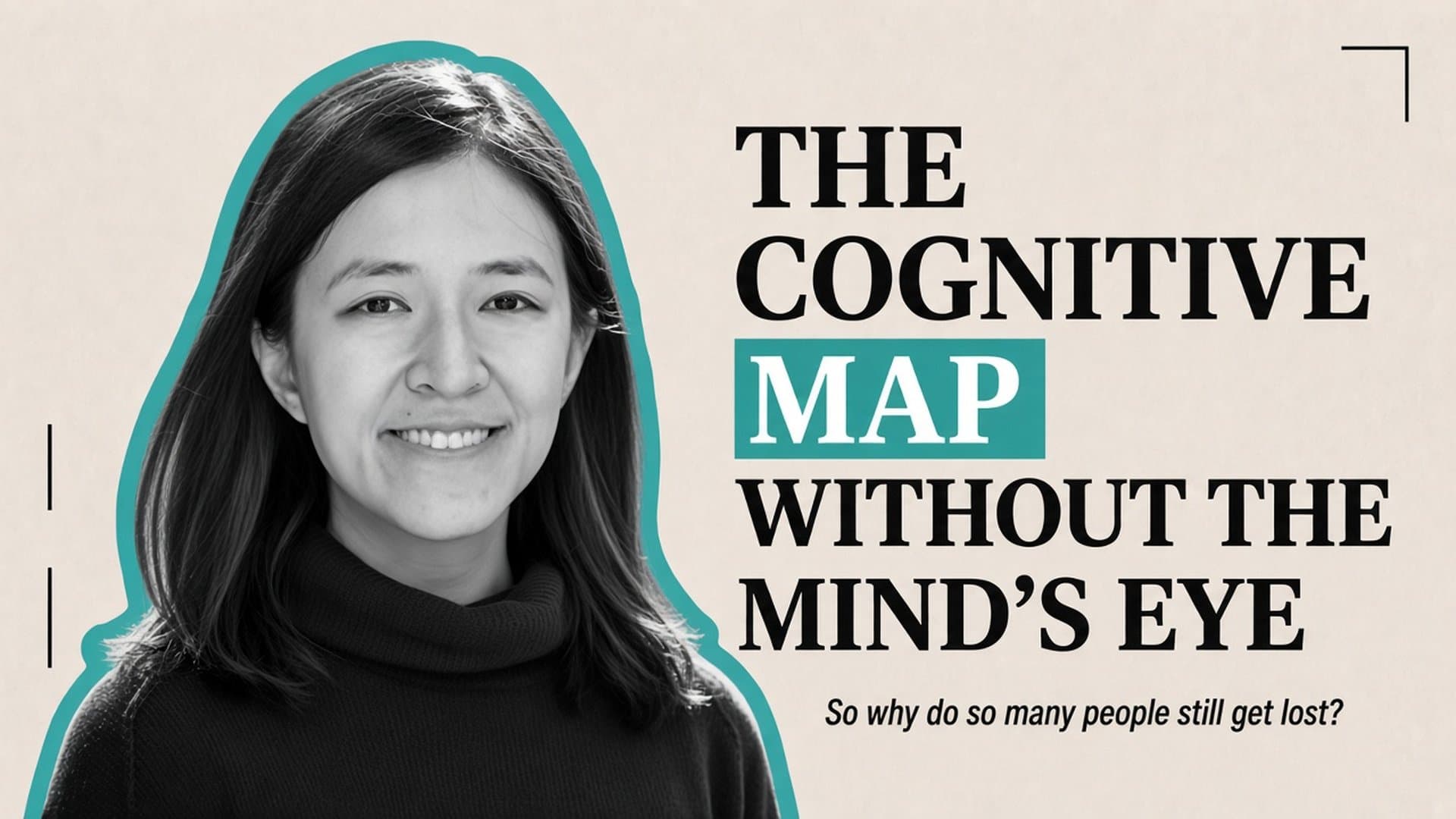
The "Cognitive Map" Without the Mind's Eye

Spatial memory is thought to be relatively unaffected in aphantasia - you can know where things are without seeing them. So why do so many people in this community still get lost? Adrienne Li put that question to the test.

๐Ÿ’ปVirtual๐Ÿ“…Scheduled๐Ÿ”’Members Only
The "Cognitive Map" Without the Mind's Eye
Spatial memory is thought to be relatively unaffected in aphantasia โ€” you can know where things are without seeing them, and many people with aphantasia do well on conventional cognitive tests.
So why do so many people in this community still get lost?
Adrienne Li's team put that question to the test with Sea Hero Quest โ€” a navigation game originally developed for dementia research and since then used to study wayfinding in hundreds of thousands of people globally. 63 participants with aphantasia (VVIQ under 32) and 99 controls learned maps, then steered through virtual environments that got steadily more complicated: longer paths, more touch points and turns, poor visibility, more to hold in mind at once.
On the easy levels, the groups looked the same.
On the hard ones, people with aphantasia took substantially longer. They also rated themselves lower on spatial ability and memory.
Spending more time on the map beforehand did not explain it. And the usual workaround โ€” talking yourself through the route โ€” did not seem to make a difference.
In new environments, and when the landscape gets complex, mental images were doing work that words could not easily replace.

๏ปฟ

What You'll Take Away

Why "spatial memory is preserved" is only half the story. How real-world navigation is far more nuanced.
What "complex" actually means in a route. Length, turns, decision points, what you can see.
Language for the next time someone treats getting lost as carelessness.
Direct answers from the researcher. Bring your questions. Adrienne will take them live.

๏ปฟ

About Adrienne

Dr. Adrienne Li is a postdoctoral researcher with the Rosenbaum Memory Lab at York University and works as a clinical neuropsychologist in the St. Michael's Hospital Family Health Team. She previously worked at the Telerehab Centre for Acquired Brain Injury at University Health Network. Her research interests include spatial and autobiographical memory, individual differences in mental imagery, and leveraging new technologies to widen access to neuropsychology.

๏ปฟ

How It Works

  1. Register free (instant for members โ€” not a member? Join in two minutes).
  1. Get the link โ€” we'll email your join details and a calendar hold.
  1. Show up live on October 9 for the talk and a real Q&A with Adrienne.

๏ปฟ

Event Details

๐Ÿ“… October 9 ยท 10:00 AM ET
๐Ÿ’ป Virtual โ€” join from anywhere
โฑ ~1 hour, including live Q&A
๐Ÿ”’ Live attendance: Members only
๐Ÿ“บ Can't make it? A full recording posts to Resources โ†’ Videos & Interviews, free for everyone.

Event Details

Fri, Oct 9, 2026 โ€ข 10:00 AM - 11:00 AM (America/New_York)

2 registered

Register for this event to access the virtual link.

Organizer

Hosted by

  • Tom Ebeyer
    Tom Ebeyer@tomebeyer
Aphantasia Logo

The "Cognitive Map" Without the Mind's Eye

Spatial memory is thought to be relatively unaffected in aphantasia - you can know where things are without seeing them. So why do so many people in this community still get lost? Adrienne Li put that question to the test.

๐Ÿ’ปVirtual๐Ÿ“…Scheduled๐Ÿ”’Members Only
The "Cognitive Map" Without the Mind's Eye
Spatial memory is thought to be relatively unaffected in aphantasia โ€” you can know where things are without seeing them, and many people with aphantasia do well on conventional cognitive tests.
So why do so many people in this community still get lost?
Adrienne Li's team put that question to the test with Sea Hero Quest โ€” a navigation game originally developed for dementia research and since then used to study wayfinding in hundreds of thousands of people globally. 63 participants with aphantasia (VVIQ under 32) and 99 controls learned maps, then steered through virtual environments that got steadily more complicated: longer paths, more touch points and turns, poor visibility, more to hold in mind at once.
On the easy levels, the groups looked the same.
On the hard ones, people with aphantasia took substantially longer. They also rated themselves lower on spatial ability and memory.
Spending more time on the map beforehand did not explain it. And the usual workaround โ€” talking yourself through the route โ€” did not seem to make a difference.
In new environments, and when the landscape gets complex, mental images were doing work that words could not easily replace.

๏ปฟ

What You'll Take Away

Why "spatial memory is preserved" is only half the story. How real-world navigation is far more nuanced.
What "complex" actually means in a route. Length, turns, decision points, what you can see.
Language for the next time someone treats getting lost as carelessness.
Direct answers from the researcher. Bring your questions. Adrienne will take them live.

๏ปฟ

About Adrienne

Dr. Adrienne Li is a postdoctoral researcher with the Rosenbaum Memory Lab at York University and works as a clinical neuropsychologist in the St. Michael's Hospital Family Health Team. She previously worked at the Telerehab Centre for Acquired Brain Injury at University Health Network. Her research interests include spatial and autobiographical memory, individual differences in mental imagery, and leveraging new technologies to widen access to neuropsychology.

๏ปฟ

How It Works

  1. Register free (instant for members โ€” not a member? Join in two minutes).
  1. Get the link โ€” we'll email your join details and a calendar hold.
  1. Show up live on October 9 for the talk and a real Q&A with Adrienne.

๏ปฟ

Event Details

๐Ÿ“… October 9 ยท 10:00 AM ET
๐Ÿ’ป Virtual โ€” join from anywhere
โฑ ~1 hour, including live Q&A
๐Ÿ”’ Live attendance: Members only
๐Ÿ“บ Can't make it? A full recording posts to Resources โ†’ Videos & Interviews, free for everyone.

Event Details

Fri, Oct 9, 2026 โ€ข 10:00 AM - 11:00 AM (America/New_York)

2 registered

Register for this event to access the virtual link.

Organizer

Hosted by

  • Tom Ebeyer
    Tom Ebeyer@tomebeyer

Event Details

Fri, Oct 9, 2026 โ€ข 10:00 AM - 11:00 AM (America/New_York)

2 registered

Register for this event to access the virtual link.

Organizer

Hosted by

  • Tom Ebeyer
    Tom Ebeyer@tomebeyer

Event Details

Fri, Oct 9, 2026 โ€ข 10:00 AM - 11:00 AM (America/New_York)

2 registered

Register for this event to access the virtual link.

Organizer

Hosted by

  • Tom Ebeyer
    Tom Ebeyer@tomebeyer