What it’s like
It’s knowing without seeing. Ask someone with aphantasia whether cherries are a darker red than strawberries and they’ll answer correctly. Ask how, and they often say, “I just know.” For some, it clicks when they learn that “picture a beach” or “count sheep” was never a figure of speech.
What’s missing or faint is the picture you call up on purpose. Pictures can still arrive on their own, in dreams or as brief flashes.
Questions people ask first
- Do you dream in pictures?Most people with aphantasia do: 63.4% in a survey of 2,000 volunteers.
- How do you remember things?Mostly as facts: you know it happened, but fewer details of the moment come back.
- Can you picture the people you love?Many people with aphantasia can’t, but say they still know what those faces look like.
- Can you imagine sounds, smells or touch?Often not: about half of 2,000 volunteers said their imagery was faint or absent in every sense.
How common is it?
About 1 in 25 people have little or no visual imagery, and about 1 in 100 have none at all. Studies put the figure anywhere from about 1 to 5 in 100, mostly depending on where they draw the line.
About 1 in 25 have little or no visual imagery
No picture: about 1 in 100A faint picture
About 6 in 100 have imagery as vivid as seeing
Everyone else has typical imagery
Researchers call faint imagery hypophantasia, which people also call partial aphantasia, and imagery as vivid as really seeing hyperphantasia. The range isn’t even: more people have imagery as vivid as seeing than have none at all.
Many people don’t know where they sit. Francis Galton noticed in 1880 that people with the least imagery were often unaware they were different, and in one survey of 2,000 volunteers with aphantasia, about 6 in 10 only realized it after age 20.
To show someone how your imagery compares, you can picture a horse and blur and fade a photo until it matches.
What causes it?
Most people with aphantasia have had it all their lives. Some lose their imagery later, after a stroke, a head injury, surgery, an illness or a new medication, or after trauma or depression. That’s called acquired aphantasia.
If your imagery faded and no doctor has looked at it yet, tell one, especially if it went suddenly, since the cause may need checking.
It seems to run in families: in one survey of volunteers with aphantasia, their siblings appeared about ten times as likely as other people to have it.
In the brain, small studies point to a weaker link between the front of the brain and the parts that handle sight. Another idea is that those visual parts are too busy at rest for a faint image to come through. Both are ideas researchers are still testing.
Is it a disorder?
One study that checked aphantasia against the four criteria for a mental disorder found it isn’t one: it met only one, being rare. But about a third of the people with aphantasia in it reported real distress. Watch Aphantasia is not a disorder.
It isn’t a problem with the eyes, either. It’s about the pictures in the mind.
Life with it varies. In one survey of 2,000 volunteers, about half named advantages, and many said it affects their relationships, mostly for the worse.
No method has been shown to give people with lifelong aphantasia imagery they can call up at will, so be wary of anyone selling one. If finding out troubles you, the guide has help.
Is it real?
Yes. Measures that don’t rely on anyone’s word, such as how the pupils respond to imagined light, find a real difference between people with aphantasia and others. They compare groups, so none of them can tell you whether you have it. The guide shows all four measures.
Where the word comes from
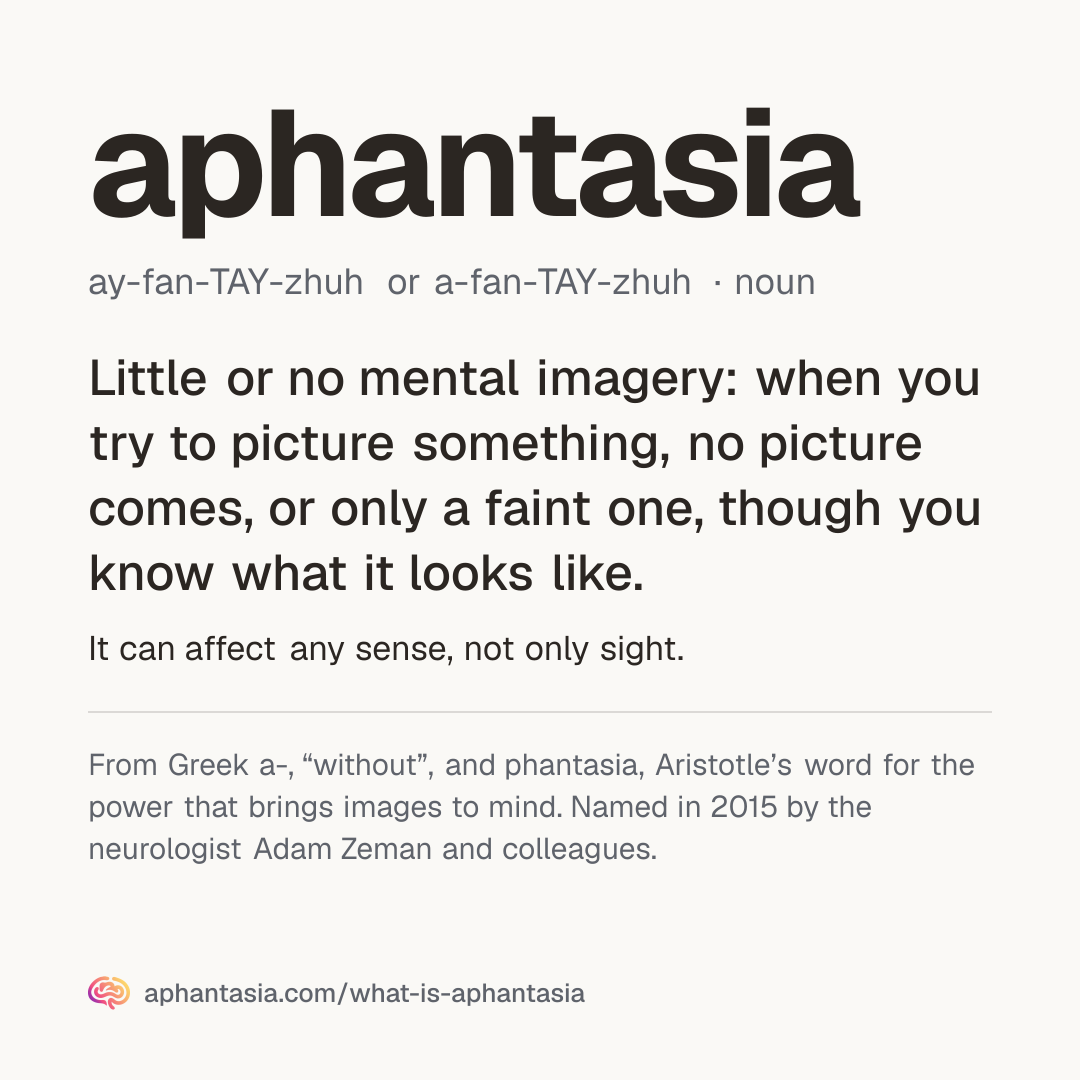
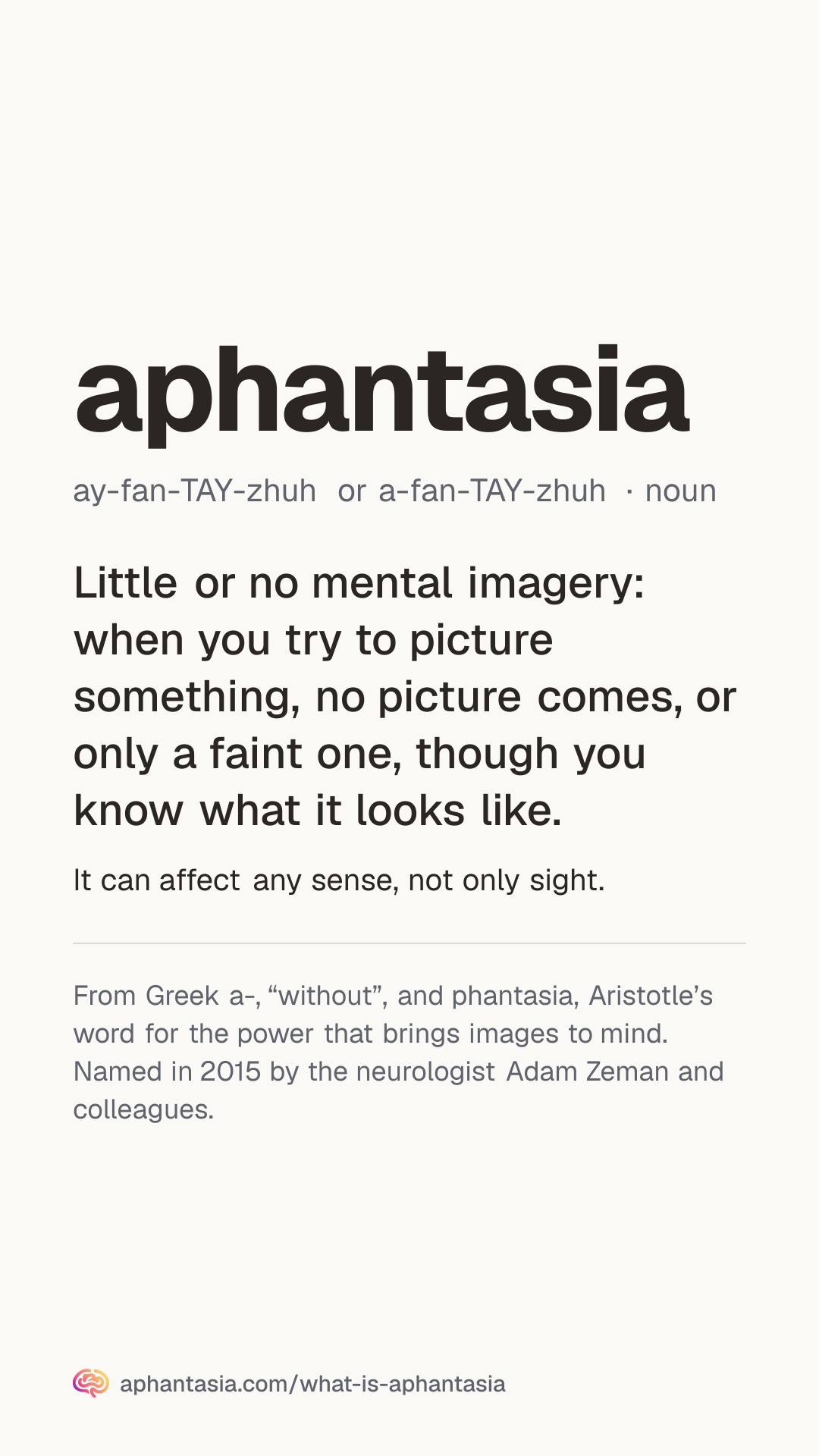
The word joins the Greek a-, “without”, and phantasia, Aristotle’s word for the power that brings images to mind. Adam Zeman and colleagues proposed it in 2015, 135 years after Francis Galton first noticed people with no imagery.
- 1880
Francis Galton asks people to picture that morning’s breakfast table. One man replies: “My powers are zero… I recollect the breakfast table, but do not see it.”
- 1900s
The finding is largely neglected for most of a century. The behaviourist John Watson calls the claim to see your childhood home in your mind’s eye “sheer bunk”.
- 2010
Zeman and colleagues describe a retired surveyor, known as MX, who lost his imagery after a heart procedure: “I can remember visual details, but I can’t see them.” When a magazine tells his story, more than twenty people write to Zeman: theirs had always been weak or absent.
- 2015
Zeman and colleagues name it aphantasia, from 21 people’s accounts. Once the name reaches the press, many thousands of people with unusually weak or vivid imagery get in touch. One of the 21, Tom Ebeyer, later founded Aphantasia Network with Jennifer McDougall.
If it sounds like you
Start with the beginner’s guide: how people find out, the one question researchers tested and what to do next.
Keep reading
Image-Free Insights
A short note from our founder, Tom Ebeyer, every other week, plus occasional news and invitations to take part in studies. Change what you get from any email.