Hypophantasia
Hypophantaisa is characterized by a low visual imagination. Hypo - meaning low. Hypophantasics, or people with hypophantasia, have described experiences almost like aphantasia, where visual imagery is completely absent. Hypophantasics may only experience flashes or struggle to create mental images. This phenomenon can extend to other senses in your imagination, such as auditory (sound), gustatory (taste), olfactory (smell) imagination, etc. Dive into stories, resources and discussions.

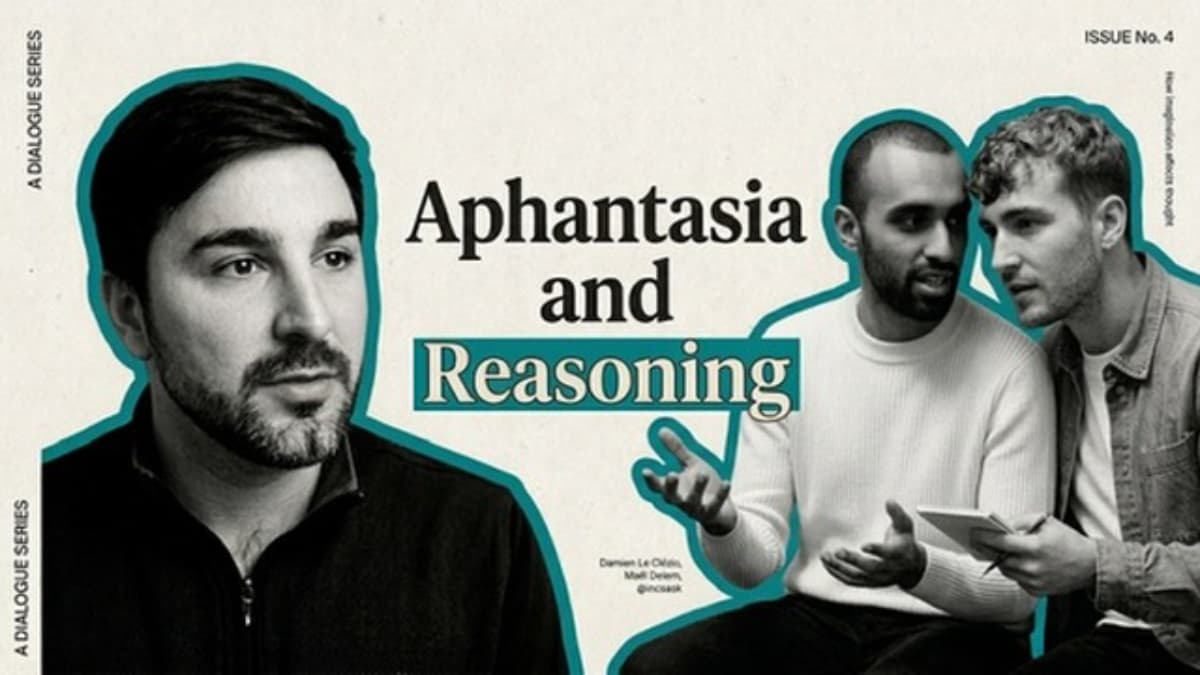
When Mental Images Get in the Way: How Aphantasia Reveals a Hidden Advantage in Reasoning
New research from the University of Lyon suggests that people with aphantasia may actually reason faster on certain logic problems—a finding that challenges the long-held assumption that mental imagery helps us think.
State but not trait measures of vividness relate to memory accuracy
Researchers found that trial-by-trial vividness predicts memory accuracy, but trait-level measures like the VVIQ do not. This suggests that moment-to-moment imagery fluctuations are more vital for memory than general imagery ability.
Duckett, W., & Simons, J. S. (2026). State but not trait measures of vividness relate to memory accuracy. Neuropsychologia, 224, 109399. doi:10.1016/j.neuropsychologia.2026.109399
Vividness of mental imagery reflects a broad range of internally generated visual experiences
Researchers found vividness ratings robustly reflect diverse internal experiences, though many people have mental depictions without literally seeing them. This suggests redefining aphantasia to distinguish between faint imagery and a total lack of pictorial representation.
Schwarzkopf, D. S., Yu, X. A., Altan, E., Bouyer, L. N., Saurels, B. W., Pellicano, E., & Arnold, D. H. (2026). Vividness of mental imagery reflects a broad range of internally generated visual experiences. Royal Society Open Science, 13(3). doi:10.1098/rsos.251887

Direct Experience: Meditation Without a Mind’s Eye
When you can't picture anything in your mind, meditation can seem off-limits. But the absence of mental imagery may be a gateway, not a barrier—one that leads more directly into presence and the heart of awareness.
AI-generated inspiration for the design process: effects across the vividness of visual imagery spectrum
AI-generated inspiration removed the link between high visual imagery and better design user experience. This suggests AI tools can level the playing field for people with aphantasia by providing the visual starting points they lack.
Lebron Flores, M. O., & Moacdieh, N. M. (2026). Ai-generated inspiration for the design process: effects across the vividness of visual imagery spectrum. International Journal of Design Creativity and Innovation, 1–19. doi:10.1080/21650349.2026.2629810

Alexander of Aphrodisias: The Ancient Philosopher Who Mapped Mental Imagery
This piece explores recently published philosophical research on Alexander of Aphrodisias (c. 200 AD) and its relevance to understanding aphantasia. While ancient philosophers couldn't have known about cognitive diversity as we understand it today, their assumptions about universal mental processes help us appreciate how differently minds can work.
Do low imagers know more words? examining the association between mental imagery and vocabulary size
Low-imagery individuals outperformed high imagers when matching highly concrete words to precise definitions. This suggests that vivid mental imagery can sometimes interfere with the analytical processing required for specific linguistic tasks.
Yavuz, M., & Nazir, T. A. (2026). Do low imagers know more words? examining the association between mental imagery and vocabulary size. Language, Cognition and Neuroscience, 1–14. doi:10.1080/23273798.2026.2614588
Multisensory Imagery Enhances the Aesthetic Evaluation of Paintings: A Virtual Reality Study
Multisensory mental imagery enhances the aesthetic appeal of paintings by increasing imagery vividness and emotional arousal. This suggests that intentional imagery can be used as a cognitive strategy to deepen aesthetic experiences.
Chen, Z., Han, Z., Wu, L., & Huang, J. (2026). Multisensory imagery enhances the aesthetic evaluation of paintings: a virtual reality study. Empirical Studies of the Arts. doi:10.1177/02762374251412761
MindEye: A VR Imagery Training System for Individuals with Acquired Visual Imagery Impairments and Mild Aphantasia
A VR system using guided imagery and spatial tasks significantly improved imagery clarity and recall in people with imagery deficits. This suggests that leveraging preserved spatial cognition can help rebuild visual imagery pathways.
Wang, T., He, C., Song, R., Zhang, J., Xu, Y., Zhang, P., Guo, M., Li, G., & Deng, Z. (2025). Mindeye: a vr imagery training system for individuals with acquired visual imagery impairments and mild aphantasia. Proceedings of the SIGGRAPH Asia 2025 Posters, 1–3. doi:10.1145/3757374.3771463
The role of subjective interoception in autobiographical deficits in aphantasia
Aphantasics report lower interoceptive awareness, which contributes to autobiographical memory deficits via mental imagery. This suggests aphantasia involves altered bodily processing that extends beyond a lack of visual imagery.
Monzel, M., Nagai, Y., & Silvanto, J. (2025). The role of subjective interoception in autobiographical deficits in aphantasia. Scientific Reports, 15(1). doi:10.1038/s41598-025-23270-x
The Aphantasia-Hyperphantasia spectrum
Aphantasia is a heterogeneous phenomenon involving multiple distinct spectrums rather than a single monolithic condition. This suggests that studying the entire spectrum is key to understanding individual differences in cognition and emotion.
Nanay, B. (2025). The aphantasia-hyperphantasia spectrum. Neuropsychologia, 109293. doi:10.1016/j.neuropsychologia.2025.109293
Absence of shared representation in the visual cortex challenges unconscious imagery in aphantasia
Neural activity during imagery in aphantasics does not share the same representational patterns as actual perception. This challenges the theory of unconscious imagery, suggesting aphantasics instead utilize alternative cognitive strategies.
Scholz, C. O., Monzel, M., & Liu, J. (2025). Absence of shared representation in the visual cortex challenges unconscious imagery in aphantasia. Current Biology, 35(13), R645–R646. doi:10.1016/j.cub.2025.05.009

Can't Visualize An Apple? Try This Apple Illusion to Experience What Others See
This apple illusion allows people who can't visualize to temporarily 'see' an image that isn't there—using visual perception to demonstrate what others experience through their imagination.
Phenomenological Studies of Visual Mental Imagery: A Review and Synthesis of Historical Datasets
Researchers identified 16 consistent characteristics of visual mental imagery across diverse historical and cultural datasets. This taxonomic template provides a more precise framework for defining imagery and refining aphantasia diagnoses.
Marks, D. F. (2023). Phenomenological studies of visual mental imagery: a review and synthesis of historical datasets. Vision, 7(4), 67. doi:10.3390/vision7040067

Are You a Visualizer or Conceptualizer? The Ball on a Table Test
The Ball on a Table experiment is a simple visualization test that reveals whether you think in pictures (visualizer) or concepts (conceptualizer). This revealing experiment, originally credited to u/Caaaarrrl, takes less than a minute but provides profound insights into how your mind processes information.

The Visualizer’s Fallacy
Understanding the hidden assumptions that lead to biases against aphantasics’ cognitive abilities.

The Language Game of Visualization: Why Aphantasics Don't Need Mental Images to Imagine
How a philosopher's investigation into a simple paradox—people who can't visualize yet excel at "visual" tasks—led him to challenge centuries of assumptions about imagination, mental images, and the nature of thought itself.
Aphantasia....Or Is It Actually Something Else
Can a disconnect in visual processing affect your ability to create mental images? Share your experiences and insights!

Do We Become More Aphantasic With Age? A Hungarian Research Team Has Some Surprising Answers
How a student's curiosity about her own family sparked a decade-long investigation into imagery vividness — and uncovered a near-perfect developmental curve that nobody had seen before.

Visualizing the Invisible
What do typical visualizers experience? How does my imaginative experience compare? Designer Melanie Scheer introduces a new way to visualize the visual imagination spectrum.