I recently had the pleasure of hosting a photography workshop for artists with aphantasia at the 2021 Extreme Imagination (Virtual) Conference. It was a fantastic opportunity to connect with other artists and creatives while we discussed photography as a medium for creation and imagination.
In this small group format, I shared my experience as a full-time photographer actively working in the industry - and
You’ve used your five free reads
Members read everything here, and put their own questions to the researchers at live talks.
Every talk recorded, with the questions
The members’ Discord, between talks
The Aphantasia Explained course, with Annual
Prices in US dollars, plus tax where it applies. 30 days to change your mind.
Chris Wooley is a photographer and educator who holds the Master Photographer and Photographic Craftsman degrees and Certified Professional Photographer status. Chris has won numerous print awards, including multiple Fuji Masterpieces, and is a recipient of the prestigious “PPA National Award” for his contributions towards the photographic industry. Visit www.cwooley.com to see more artwork by Chris.
Was this helpful?
how I embraced my total aphantasia
- and leveraged its advantages to strengthen my work. We also explored some training techniques anyone can do to expand their photographic talent.
Photography and Aphantasia
Before we delve into the techniques of the workshop, I think it’s important to understand how most other photographers approach the image making process - as we’ll be deviating from the norm. From my experience, most photographers at the top of their game have some form of above average visualization, with many having hyperphantasia - seeing things more vivid and real than in real life. Almost every photographer I spoke with would create an image in their mind - and then set out to recreate it in the real world. In its most basic form, they’d visualize what their final product would look like and then start on the task of creating it.
As you may have guessed, I can’t do that. And chances are if you’re reading this, neither can you. Instead, I take a different approach to create pieces of artwork - embracing my strengths and abilities as an aphantasic artist.
Let’s dive into my process - and hopefully you might find a few techniques that work for you.
Start With A Concept
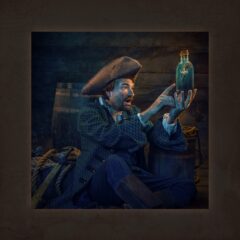
Just like my visual friends, I start with an idea - a concept of what I want to photograph. I’m drawn towards storytelling illustrative subjects. And I love pirates. So I’ll come up with an idea of having a pirate holding a bottle with a mini-mermaid in it. I can’t see that idea in my head, but I have a basic idea of what I want to do. I now have a concept.
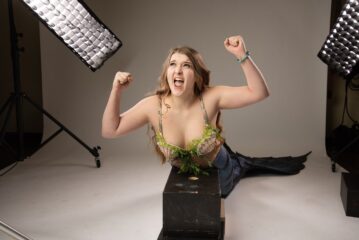
Mermaid by Chris Wooley Photography
Nurture The Idea Live
Over the years, I’ve tried several approaches to the next step. I used to sketch out the idea, playing with composition, position, and coloring. I’ve had exactly 0 of those ideas ever work out in the final project. It used to frustrate me to no end - having an idea but not being able to execute it how I’d hoped it would look in my crude sketch. Too much planning made me a worse artist.
I finally found an approach that worked really well for me. I’d start with my base idea as a starting point, using it for guidance rather than as a strict template to follow. It is a seed I plant, not knowing how it will grow. I take that idea and nurture it, adding what it needs to come to life, and removing things that hold it back. I don’t force it; I let the piece tell me what it needs (using classic design elements as my tools).
See What The Image Needs, Give It To It
This is where having practice and perspective comes into play. I use analytical thinking, design rules and theories, and intuition to help shape and nurture the artwork. I want to use browns and blues as my primary colors; they are complimentary, and fit the sea/ship color palette. I want my pirate to be looking towards the right because the viewer’s eye will enter from the left and go right. I want to motivate the light from a lantern (off camera). I’ll use a sword to keep the viewer’s eye locked into the frame. Lots of tiny elements that all come together to help tell the story. Each decision is motivated by what it adds to the final image.
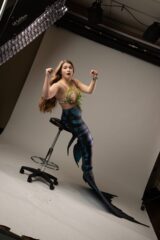
Mermaid 2 by Chris Wooley Photography
I combine elements, experiment, and play. It is this process that allows my concept to come to life in a natural and organic way. It’s a technique I’ve embraced after trying so hard to do things how other artists that visualize. I embrace my strengths.
Expand Your Design Vocabulary
The key to this approach is to expand your design vocabulary - either formally or casually. I do a mixture of both. I love reading design books and taking art classes (even outside my genre). The core concepts are the same, even though the medium may vary. But more practically, I find artwork that inspires me and save it in an inspiration folder. Cool use of color - SAVED! Strong composition - SAVED! Awesome perspective - SAVED! Great retouching - SAVED! I find images that speak to me and save them. I have a folder on my phone and on my computer filled with inspiration.
Captivated by Chris Wooley
Experiment With It
This next step is the important one - I then go through the images and start evaluating them. WHY do I like them? What is working? I take mental note of what I enjoyed about the image. It is the critical thinking on the WHY that helps expand your design knowledge. Then, when it comes to creating a new piece, I pull inspiration from MULTIPLE sources. I like these colors. I like this composition. I like this processing. Those are all tools I use when crafting an image - seeing what will play well with my core concept. Some work really well. Others don’t. But it is the experimentation that helps the final piece come alive.
You now know my strategy for creating photographic artwork with aphantasia: start with a concept and then nurture the idea live, pulling from inspiration and classic design. See what the image needs, and give it to it. See what is holding it back, and remove it. Experiment with it. And once you follow this process you’ll see your original concept come to life in a new and unique way.
Video of Chris' Creative Process
I recently had the pleasure of hosting a photography workshop for artists with aphantasia
A short note from our founder, Tom Ebeyer, every other week, plus occasional news and invitations to take part in studies. Change what you get from any email.
Direct Experience: Meditation Without a Mind’s Eye
When you can't picture anything in your mind, meditation can seem off-limits. But the absence of mental imagery may be a gateway, not a barrier—one that leads more directly into presence and the heart of awareness.
Linda Wright · February 2026
The Power of Abstract Thinking in Aphantasia
The concept of 'tokens' and 'types' helped me understand how we think differently: visualizers use specific imagery, while aphantasics excel in abstract thinking.
Tom Ebeyer · February 2024
3 Ways to Motivate Yourself Without Visualization
How do you stay motivated to achieve your goals if you can't visualize them? Discover alternative motivational strategies without visualization.