How people find out
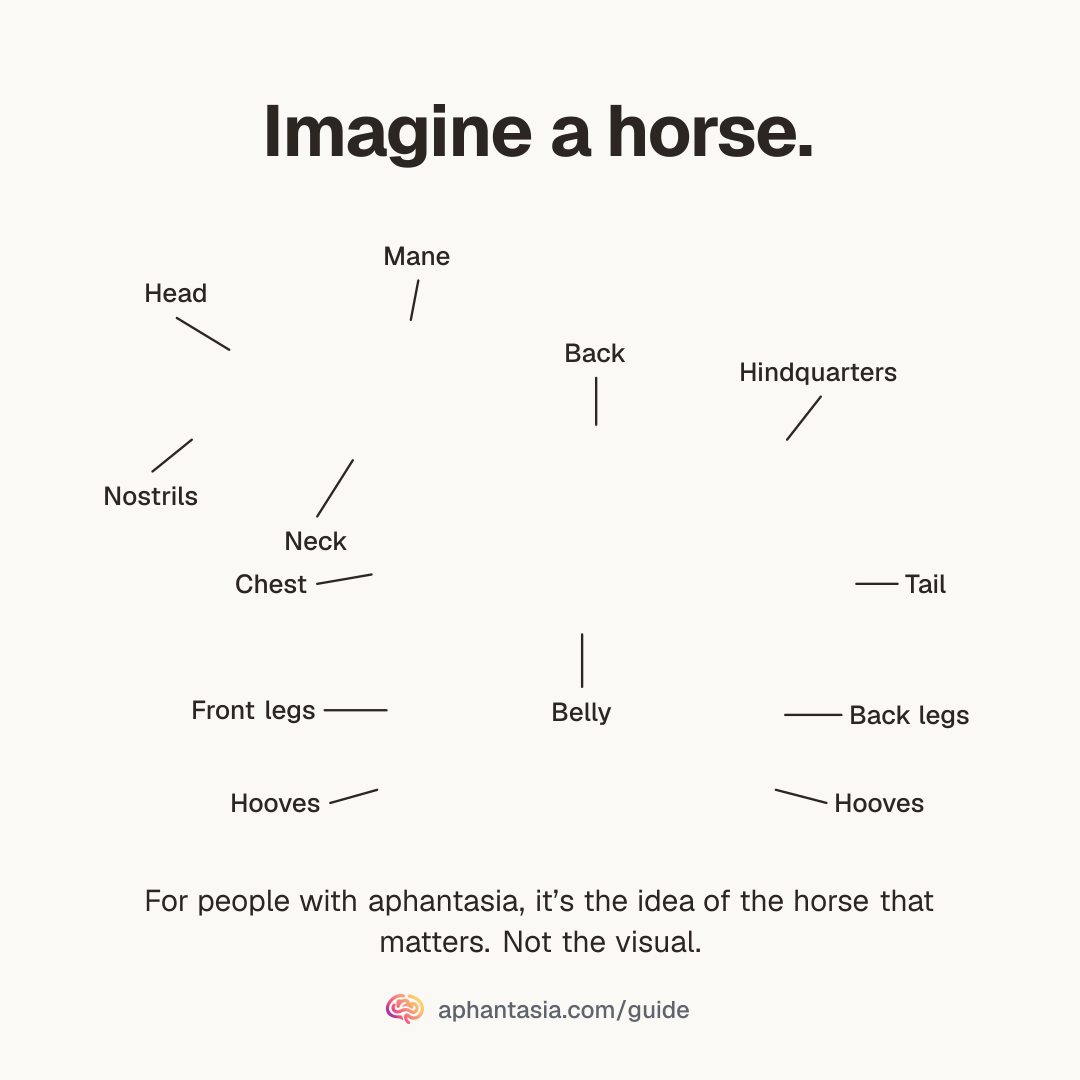
Maybe it was a TikTok song, or the meme that asks you to picture a red apple. Somewhere along the way you learned that when most people try, a shiny red apple actually appears. If that came as a shock, you’re not the only one: in one survey of 2,000 volunteers with aphantasia, about 6 in 10 only realized it after age 20, most often by comparing their experience with friends and family.
There’s no medical test for aphantasia, and it isn’t a diagnosis. Researchers usually measure it with a questionnaire that asks people how vivid their imagery is.
The question researchers tested
One question has been tested against the full 16-item questionnaire, in more than 13,000 people who took it on this site. It asks for a whole place in every detail, which is hard to picture, and the study’s authors credit that difficulty with how few people with imagery answer 1. One of our founders, Tom Ebeyer, is one of the study’s authors.
We don’t store your answer.
Things people notice
You might recognize some of these. None of them is a test.
- “Picture a beach” or “count sheep” always sounded like a figure of speech.
- You know what a friend looks like, but can’t bring their face to mind.
- You remember what happened on a day more than how it looked.
- Guided meditations that ask you to picture a place leave you with nothing to look at.
What other people see
For most people, trying to picture something brings a picture. How clear it is varies: on the full questionnaire, about 1 in 100 people get no picture at all, about 1 in 25 get a faint one or none, and about 6 in 100 get one as vivid as really seeing. Everyone else falls in between.
Try it: the afterimage apple
Stare at the dot on the apple without moving your eyes. When the time is up, the panel turns white.
It’s a trick of the eyes, not imagination, but it gives a rough idea of what some people mean by seeing something that isn’t there. More on the afterimage apple.
Knowing without seeing
A quick way to feel the difference between picturing and knowing. It takes two minutes, and it works on friends too. Thanks to u/Caaaarrrl on Reddit, who came up with it.
Step 1 of 3
Picture a ball on a table. Someone walks up and gives the ball a push. What happens?
A visualizer may already know, and add details nobody asked for. One might say: “It’s like the Pixar ball, yellow with a blue stripe and a red star, on a scratched oak table.”
Someone who thinks in concepts may know only the gist, that a pushed ball rolls and may fall off, and choose the colour, the size and the table when asked. Neither way is wrong. It’s the difference between seeing a scene and knowing it. More on the ball on the table.
Is it real?
People with aphantasia are sometimes told they aren’t trying hard enough. Measures that don’t rely on anyone’s word find a real difference.
Pupils
Picture a bright, sunny sky and your pupils narrow a little, as they would in real light.
In 18 people with aphantasia, imagined light made no difference on average. Their pupils still widened with effort, so they were almost certainly trying.
Which pattern wins
Imagine a striped pattern, then look at a display that shows each eye a different one. The pattern you imagined tends to win.
It did in 209 people from the general public. In 15 people with aphantasia, the imagined pattern won no more often than the other.
Skin
Read a frightening story, a shark attack, say, and your skin sweats a little.
In 22 people with aphantasia, it didn’t. Frightening photos made both groups sweat, so it wasn’t a general dulling of feeling.
The brain
In a brain scanner, trying to imagine switched on the same visual areas in people with aphantasia as in typical imagers.
The link between those areas and regions at the front and top of the brain was weaker. The authors suggest the brain can hold visual information without it becoming a picture you see. The study had 10 people in each group.
Measures like these are beginning to back up what people with aphantasia say about their imagery (Zeman, 2024). But they compare groups, so none of them can tell you whether you have aphantasia.
Telling the people in your life
Most people you tell can picture things, so it may take them a while to believe you don’t see pictures the way they do. Questions and doubts are normal.
I have aphantasia. When I imagine something, I know what it looks like, but no picture comes. About 1 in 25 people have faint or no visual imagery, and most have had it all their lives. It’s a different way a mind can work.
- Alex
- There’s something I’ve been wanting to tell you. I found out I have aphantasia.
- Jordan
- Aphant-what?
- Alex
- Aphantasia. When I try to picture something, like a beach, no picture comes. I know what a beach is. I just don’t see one.
- Taylor
- So when you read a book, you don’t see the scenes?
- Alex
- No. I follow the story and feel it, but I don’t see it.
- Jordan
- Maybe you’re just not trying hard enough.
- Alex
- I used to think that too. But it isn’t about effort. It’s how my mind works.
- Taylor
- Can you picture my face?
- Alex
- No, but I know what you look like, and I’d know you anywhere.
- Jordan
- How do you dream, then?
- Alex
- Most people with aphantasia dream in pictures. Mine are more about feelings, but we’re not all the same.
- Jordan
- It’s hard to get my head around. But I believe you.
- Alex
- Thanks. That means a lot.
Questions people ask first
What do other people actually see?
Most people see a picture when they try, anywhere from dim to as vivid as seeing.
How clear the picture is varies. On the full questionnaire, about 1 in 100 people get no picture at all, about 1 in 25 get a faint one or none, and about 6 in 100 get one as vivid as really seeing. Try the afterimage apple for a rough idea of seeing something that isn’t there.
Do you dream in pictures?
Most people with aphantasia do: 63.4% in a survey of 2,000 volunteers.
Pictures can arrive on their own even when you can’t call them up. In the 2015 study that named aphantasia, 17 of 21 people had them in dreams, and 10 of 21 had brief flashes while awake.
Liana M. Scott writes about the pictures that come between sleep and waking in Hypnopompia. How do you dream? Join the discussion.
How do you remember things?
Mostly as facts: you know it happened, but fewer details of the moment come back.
In interviews about their past, people with aphantasia recall fewer details of the moment itself, what happened, what they saw and felt, where and when, even when asked for more. General facts hold up. You may not relive a memory, but you know it happened.
Read what the research says about remembering the past, the biochemist Alice Grebanier on learning and remembering, with or without aphantasia, and her story of the 1963 solar eclipse.
Can you picture the people you love?
Many people with aphantasia can’t, but say they still know what those faces look like.
As one person put it in a 2026 interview study: “I can’t picture my mum’s face, but I still know what she looks like.”
Photos, voice notes and written memories can hold some of what a picture in the mind would. The photographer Chris Wooley on photography, creativity and aphantasia.
Do you recognize faces?
Usually. In an online face test, face blindness was no more common with aphantasia, though in another study about 4 in 10 said faces were hard.
In an online test of 65 people with aphantasia and 55 without, face blindness was no more common with aphantasia, though faces and cars were both recognized a little less accurately. On a questionnaire in another study, 42% of people with aphantasia reported difficulty with faces, against 2.5% of others.
Moritz Dürr writes about faces and memory in Memories inside Schrödinger’s box. Do you recognize faces? Join the discussion.
Can you imagine sounds, smells or touch?
Often not: about half of 2,000 volunteers said their imagery was faint or absent in every sense.
Some people can’t see a picture but can hear a tune or feel a texture in their mind. When imagery is missing in other senses as well as sight, it’s often called multisensory aphantasia.
Steven Levithan on three things he learned from having multisensory aphantasia, and the musician Neesa Sunar on playing music with it. More in multisensory aphantasia.
Were you born this way?
Most people were. Some lose their imagery after an illness, an injury, trauma or a new medication.
Losing imagery later in life is called acquired aphantasia. If yours faded and no doctor has looked at it yet, tell one, especially if it went suddenly, since the cause may need checking.
The modern story of aphantasia began with one such case: MX, a retired surveyor who lost his imagery after a heart procedure. Adam Zeman tells it, with MX himself, in Blind mind’s eye. More in acquired aphantasia.
Does it run in families?
It seems to: in one survey of volunteers with aphantasia, their siblings appeared about ten times as likely as other people to have it.
The figure comes from a 2020 survey by Adam Zeman’s team, who named aphantasia, and he repeats it in a 2024 review. Watch how he came to name it.
Is it a disorder?
One study found it isn’t one, though about a third of the people with aphantasia in it reported real distress.
In one study, judged against four criteria for a mental disorder, aphantasia met only one: being rare. That doesn’t make finding out easy, and if it troubles you, there’s help. Watch Aphantasia is not a disorder.
How does it change daily life?
It varies. In one survey of 2,000 volunteers, about half named advantages, and many said it affects their relationships, mostly for the worse.
Diane Currie Richardson spent her working life as a sign language interpreter: Interpreting in the dark. Laura Rincon on embracing aphantasia, and Mette Leonard Høeg on why aphantasia can be a gift to philosophers and critics.
Common myths
Once you know, it’s tempting to put the aphantasia stamp on everything you find hard. Not every struggle comes from it, and some things said about aphantasia aren’t true.
- “People with aphantasia get lost.”
- In one online study, people with aphantasia rated their ability to find their way, and their spatial memory, about the same as other people did. In an online drawing study, they also placed objects from memory as accurately as typical imagers. Read how others find their way.
- “People with aphantasia don’t enjoy fiction.”
- In one study of 47 readers with aphantasia, they liked fiction as much as other readers and read as many books a year, though they felt less absorbed in the one story they read. The author Kim Zarins on imagination without images.
- “Aphantasia can be cured.”
- No method has been shown to give people with lifelong aphantasia imagery they can call up at will, so be wary of anyone selling one. Dustin Grinnell’s science-fiction story imagines a cure, and what it costs.
- “People with aphantasia can’t be artists.”
- In a 2024 review, Adam Zeman wrote that creative work by people with aphantasia suggests imagery isn’t needed for creative imagination. Elina Cerla on why we don’t need visualization to make visual art, and Peta Tranquille on drawing what she couldn’t “see”.
- “You can’t meditate with aphantasia.”
- You can. Meditations built on pictures can be frustrating, but plenty don’t use pictures at all. Liana M. Scott on meditation with aphantasia, and a guided meditation by Auri’An Lay that needs no mind’s eye.
- “You can’t be hypnotized.”
- Hypnotherapists who work with aphantasia say you can. Paulina Trevena explains in Can hypnosis work on those with aphantasia?
If it’s hard to take in
Finding out can be a shock. The flashbacks in films, the police sketch artist: suddenly they turn out to be real for other people. It’s normal to have a strong reaction.
Aphantasia isn’t a disorder, but about a third of the people in one study reported real distress about it. If it troubles you, talk it through, with others who have it in our discussions, or with a therapist. Not every therapist knows about aphantasia yet, so here’s how to talk to a therapist about it, and a directory of therapists, counsellors and coaches who say they understand it.
Where to find people who think this way
Once you’ve had time to take it in, talking with people who think this way can help. Here’s where they are.
On Aphantasia Network
Discussions
Ask anything and read what others found. Anyone can read; a free account lets you post.
Read the discussionsMeetups
Members meet online every month, people who just found out and people who have known for years.
Talks with researchers
Members hear from aphantasia researchers live and ask them questions. Every talk is recorded.
Down the rabbit hole
There’s a lot more to find: members’ stories, what the research says and talks with researchers. Or let it come to you.
Image-Free Insights
A short note from our founder, Tom Ebeyer, every other week, plus occasional news and invitations to take part in studies. Change what you get from any email.
Thank you to our community contributors Neil Kimmelfield, Auri’An Lay, Liana M. Scott and Mike Swanson for their feedback on the first version of this guide.