Mental Rotation Tasks: The Surprising Advantage of Aphantasia
Discover how people with aphantasia excel at mental rotation despite having no visual imagery. Complete these mental rotation tasks and explore the fascinating cognitive differences.
Mental rotation tasks involve rotating mental representations of objects in your mind – a crucial cognitive skill used in spatial reasoning and everyday problem-solving.
You use mental rotation when:
Solving puzzles or playing Tetris
Reading maps and determining which direction to turn
You’ve used your five free reads
Members read everything here, and put their own questions to the researchers at live talks.
Every talk recorded, with the questions
The members’ Discord, between talks
The Aphantasia Explained course, with Annual
Prices in US dollars, plus tax where it applies. 30 days to change your mind.
Sources
2010
Loss of imagery phenomenology with intact visuo-spatial task performance: A case of ‘blind imagination’
Figuring out if luggage will fit in your car trunk
Imagining how furniture would look rearranged in a room
Some leading researchers studying aphantasia have used mental rotation tasks to better understand how the visual processing system may differ in the brain of aphantasics, with surprising conclusions.
How Mental Rotation Works: The Standard Process
Traditional mental rotation research suggests these cognitive stages:
Create a mental image of the object
Rotate the object mentally clockwise or counterclockwise
Compare it to another object
Decide if the objects match
Record your decision and completion time
Researchers Roger Shepard and Jacqueline Metzler developed the first standardized mental rotation test in 1971. Modern versions still follow their approach: present a 2D or 3D object alongside similar objects, then ask participants to identify which matches the original when rotated.
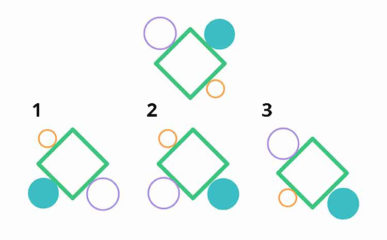
Instructions: Which of the three 2D objects matches the first object when rotated?
Record your answer and completion time.
Answers at the bottom.
Task 2: 3D Mental Rotation
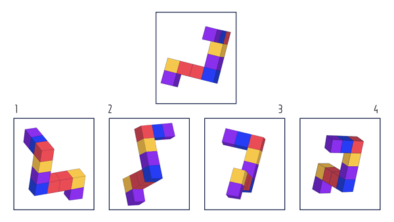
Instructions: Which of the four 3D objects matches the first one when rotated?
After completing this task, reflect on your cognitive strategy. Did you visualize the rotation, or use a different approach?
Answers are at the bottom.
Task 3: Complex 3D Mental Rotation with Folds
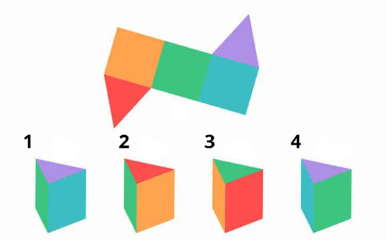
Instructions: Which of the five colorful 3D objects matches the first one when folded and rotated?
Record your answer, completion time, and cognitive strategy insights.
Answers at the bottom
The Aphantasia Advantage: Surprising Research Results
Here's where it gets interesting: people with aphantasia actually perform better on mental rotation tasks!
This finding seems counterintuitive. If mental rotation requires visualization (stages 1-2 above), how can people who can't visualize excel at these tasks?
The Case of Patient MX: Groundbreaking Discovery
Professor Adam Zeman's research at the University of Exeter revealed fascinating insights through patient MX, who lost his ability to generate visual images but performed normally on visual perception and memory tests.
Key findings:
MX completed mental rotation tasks perfectly despite having no visual imagery
fMRI scans showed reduced activity in posterior brain regions
Increased activity in frontal brain regions compared to controls
People with aphantasia average more correct answers on mental rotation tasks
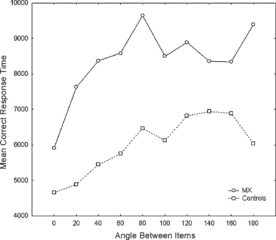
Completion times are typically longer but accuracy is higher
Mean correct response time on mental rotation for Patient MX and five matched controls.
Alternative Cognitive Strategies in Aphantasia
Non-aphants might visualize the object and rotate it inside their mind to see if they can make it match one of the other objects. This means they rely primarily on the visual circuitry in their brain to complete such tasks. Cognitive stages 1 to 5 above do a good job of describing the average person’s mental model when completing these tasks.
The aphantasic brain, however, is far from average.
How do people without visual imagery complete visual rotation tasks? The aphantasic brain uses different cognitive strategies that don't rely on conscious visualization.
Possible alternative strategies might include:
Logical reasoning about object properties
Systematic analysis of angles and relationships
Unconscious visual processing without conscious awareness
Spatial reasoning without mental imagery
This challenges traditional assumptions about the connection between visual imagery and spatial reasoning abilities.
What These Cognitive Differences Mean
These findings suggest that visual imagery ability and spatial imagery as evidenced by mental rotation performance can be separate cognitive functions. This discovery raises important questions:
How does spatial processing differ in aphantasic brains?
What alternative problem-solving strategies do they use?
How can we apply these insights to improve cognitive abilities?
Factors Affecting Mental Rotation Performance
Remember that many factors influence mental rotation results beyond aphantasia:
Age and cognitive development
Sex differences in spatial processing
Overall spatial skills and experience
Practice with similar tasks
Attention and concentration levels
Test Your Mental Rotation Abilities
Try these tasks with friends and compare results. You might discover that:
Aphantasic individuals often score higher or similar overall
Completion times vary between cognitive strategies
Different approaches can be equally effective
For more mental rotation practice, search online for additional examples, but remember these tasks aren't definitive aphantasia diagnostics.
The Bigger Picture: Rethinking Mental Imagery
This research fundamentally challenges how we understand the relationship between conscious visual imagery and spatial cognition. It suggests that:
Multiple cognitive pathways can achieve the same results
Conscious visualization isn't always necessary for "visual" tasks
The brain's flexibility in problem-solving exceeds our expectations
Individual cognitive differences deserve more research attention
How Do You Perform on the Mental Rotation Tasks?
We'd love to hear about your mental rotation experience! Share in the comments:
Your task answers and completion times
Insights into your cognitive strategy
How your approach compares to friends or family
Leave a comment below.
Mental Rotation Task Answers
Task 1 (2D): Answer 1
Task 2 (3D): Answers 1 and 4
Task 3 (3D with folds): Answers 1 and 2
What Are Mental Rotation Tasks?
Mental rotation tasks involve rotating mental representations of objects in your mind – a crucial cognitive skill used in spatial reasoning and everyday problem-solving.
Aphantasia Network is shaping a new, global conversation on the power of image-free thinking. We’re creating a place to discover and learn about aphantasia. Our mission is to help build a bridge between new scientific discoveries and our unique human experience — to uncover new insight into how we learn, create, dream, remember and more with blind imagination.
Founder of Aphantasia Network and one of the pioneering 21 cases that brought aphantasia to light. With a personal journey deeply intertwined with the phenomenon, Tom is at the forefront of raising awareness, fostering community, and championing the unique experiences of those with aphantasia
Was this helpful?
Image-Free Insights
A short note from our founder, Tom Ebeyer, every other week, plus occasional news and invitations to take part in studies. Change what you get from any email.
Aphantasia and ADHD: You Asked, We Dug Into the Research
If you've ever felt like your aphantasia and ADHD are tangled together in ways you can't quite explain, you're not alone. Researchers are beginning to untangle that same thread — and what they're finding suggests the mind's eye depends on attention in ways we're only starting to understand.
Tom Ebeyer · October 2025
Mental Health Breakthrough: Aphantasia Does Not Shield Against PTSD
How aphantasia affects mental health treatment, revealing that while aphantasics don't experience visual flashbacks, they still feel emotions intensely, requiring alternative therapeutic approaches beyond traditional imagery-based techniques.
Reshanne Reeder · March 2025
Unconscious Imagery in Aphantasia: Understanding The Scientific Debate
Have you ever described a memory in vivid detail despite seeing nothing in your mind? It raises a fascinating question: could our brains be processing images... we just can't consciously access?