Command Palette

Search for a command to run...

Cognition

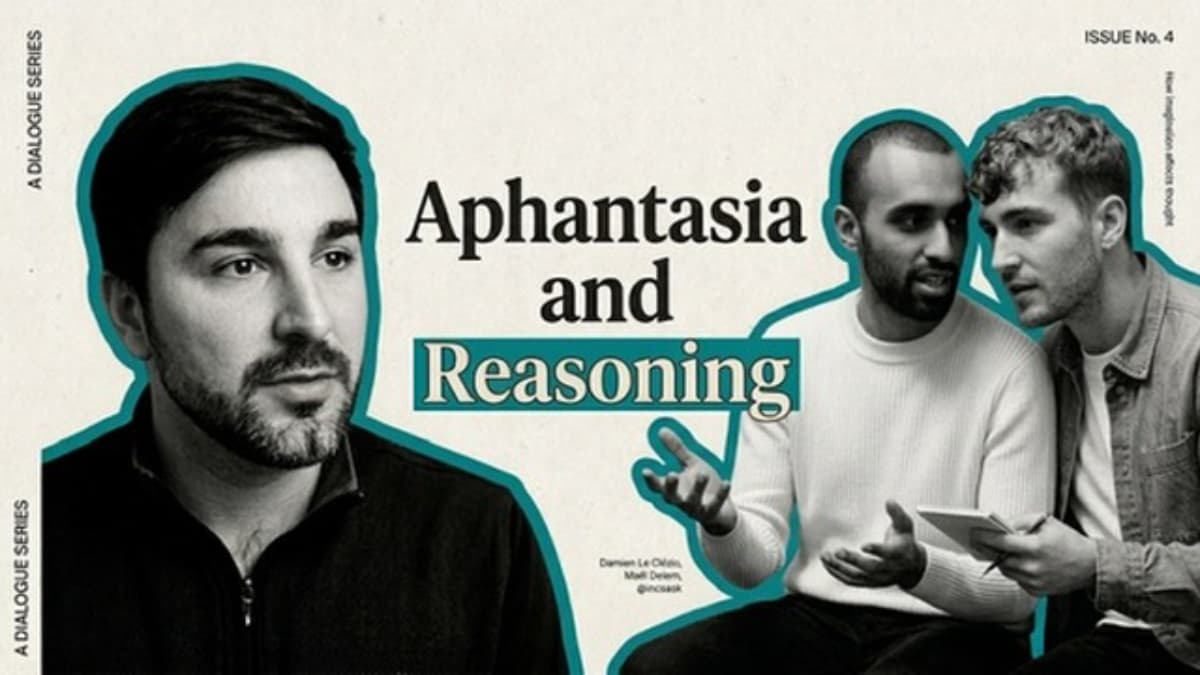
How do people with aphantasia think? While lacking mental imagery, aphantasics develop diverse cognitive strategies - often relying on verbal, semantic, or abstract thought patterns. This cognitive variation challenges traditional assumptions about the role of mental imagery in thinking, creativity, learning, memory, and more. Research suggests aphantasia influences but doesn't impair cognitive processes. Many aphantasics report thinking in words, concepts, or other non-visual and non-sensory forms, demonstrating the brain's remarkable adaptability. On this page, you'll find research exploring aphantasic cognition, personal accounts of thinking styles, and discussions about different cognitive strategies used by the aphantasia community.

Reference

Aphantasia and Motor Imagery: A Step Further in Understanding Imagery and its Role in Motor Cognition

Aphantasics showed reduced right-brain activation and increased left middle frontal gyrus activity during motor imagery. This suggests they use compensatory semantic strategies, indicating mental imagery is not essential for motor cognition.

Peruski, A. (2026). Aphantasia and motor imagery: a step further in understanding imagery and its role in motor cognition. Journal of Neurophysiology. doi:10.1152/jn.00608.2025

about 2 months ago
Rethinking Mental Imagery: Why Scientists Had It Wrong (And Why That's Good News)
Video

Rethinking Mental Imagery: Why Scientists Had It Wrong (And Why That's Good News)

For decades, neuroscientists assumed they understood mental imagery. Then people with aphantasia proved them wrong—and changed the future of consciousness research.

3 months ago
Reference

The Aphantasia-Hyperphantasia spectrum

Aphantasia is a heterogeneous phenomenon involving multiple distinct spectrums rather than a single monolithic condition. This suggests that studying the entire spectrum is key to understanding individual differences in cognition and emotion.

Nanay, B. (2025). The aphantasia-hyperphantasia spectrum. Neuropsychologia, 109293. doi:10.1016/j.neuropsychologia.2025.109293

5 months ago
Reference

Absence of shared representation in the visual cortex challenges unconscious imagery in aphantasia

Neural activity during imagery in aphantasics does not share the same representational patterns as actual perception. This challenges the theory of unconscious imagery, suggesting aphantasics instead utilize alternative cognitive strategies.

Scholz, C. O., Monzel, M., & Liu, J. (2025). Absence of shared representation in the visual cortex challenges unconscious imagery in aphantasia. Current Biology, 35(13), R645–R646. doi:10.1016/j.cub.2025.05.009

8 months ago
Reference

Beyond words: Examining the role of mental imagery for the Stroop effect by contrasting aphantasics and controls

People with aphantasia showed a reduced Stroop effect in accuracy compared to controls. This suggests that mental imagery of color words interferes with perception, identifying imagery as a partial cause of this cognitive interference.

Monzel, M., Rademacher, J., Krempel, R., & Reuter, M. (2025). Beyond words: examining the role of mental imagery for the stroop effect by contrasting aphantasics and controls. Cognition, 259, 106120. doi:10.1016/j.cognition.2025.106120

9 months ago
The Power of Abstract Thinking in Aphantasia
Article

The Power of Abstract Thinking in Aphantasia

The concept of 'tokens' and 'types' helped me understand how we think differently: visualizers use specific imagery, while aphantasics excel in abstract thinking.

about 2 years agoby Tom Ebeyer
Are You a Visualizer or Conceptualizer? The Ball on a Table Test
Article

Are You a Visualizer or Conceptualizer? The Ball on a Table Test

The Ball on a Table experiment is a simple visualization test that reveals whether you think in pictures (visualizer) or concepts (conceptualizer). This revealing experiment, originally credited to u/Caaaarrrl, takes less than a minute but provides profound insights into how your mind processes information.

over 2 years agoby Aphantasia Network and
The Visualizer’s Fallacy
Article

The Visualizer’s Fallacy

Understanding the hidden assumptions that lead to biases against aphantasics’ cognitive abilities.

over 2 years agoby Christian Scholz
When Your Brain Runs in Reverse: A Neuroscientist's Journey Through Aphantasia
Video

When Your Brain Runs in Reverse: A Neuroscientist's Journey Through Aphantasia

What happens when a neuroscientist studying visual hallucinations discovers he can't visualize at all? Mac Shine's personal revelation led to groundbreaking insights about how our brains create—and fail to create—mental imagery.

over 2 years ago
The Language Game of Visualization: Why Aphantasics Don't Need Mental Images to Imagine
Video

The Language Game of Visualization: Why Aphantasics Don't Need Mental Images to Imagine

How a philosopher's investigation into a simple paradox—people who can't visualize yet excel at "visual" tasks—led him to challenge centuries of assumptions about imagination, mental images, and the nature of thought itself.

over 2 years ago
Are People with Aphantasia Verbal Thinkers?
Video

Are People with Aphantasia Verbal Thinkers?

Julia Simner addresses a common misconception that aphantasics must be verbal thinkers in this presentation from the 2021 Extreme Imagination Conference.

over 4 years ago
Discussion

Do you think in words?

over 4 years agoIan

Do others create complex mental models without relying on words, or is this way of thinking unique to some?

Discussion

Thinking: Visual vs Abstract vs Verbal vs Logic vs Connective vs Kinesthetic etc.

over 4 years agoWill

Exploring the interplay of visualization, abstraction, and logic reveals diverse cognitive processes—each shaping unique thought experiences.

Discussion

If you have not images, how can you think?

almost 5 years agoRobert

How do you process thoughts without visual imagery? Is it like an internal conversation, or do you experience auditory imagination instead?

Learning with Aphantasia: Exploring the Potential Limitations and Opportunities for Aphantasic Learners
Article

Learning with Aphantasia: Exploring the Potential Limitations and Opportunities for Aphantasic Learners

There's no right or wrong way to learn – just different approaches that work for different minds.

about 6 years agoby Aphantasia Network and
Think of a Horse: Describing Aphantasia
Article

Think of a Horse: Describing Aphantasia

How do you describe aphantasia? Founder of Aphantasia Network often gets asked this question. His answer? Think of a horse.

about 7 years agoby Tom Ebeyer

You've reached the end of content in the cognition topic.